

Promote top Chamet hosts to sub-agent when their team consistently hits $5,000+ in 30-day revenue, unlocking 15% commission tiers and override earnings. This guide reveals exact thresholds, break-even calculations, and performance metrics for optimal promotion timing in 2025's updated commission structure.
Understanding the Chamet Sub-Agent Role: 2025 Updates
Chamet's agency system operates on multi-tiered commissions where sub-agents earn overrides on recruited team performance while maintaining personal hosting. Unlike standard hosts earning solely from viewer interactions, sub-agents generate dual income: direct hosting plus team management commissions.
2025 commission structure scales from 5% at $500 monthly team revenue to 30% at $50M+, with critical breakpoints at:
$5,000 (15%)
$15,000 (18%)
$50,000 (20%)
Sub-agent overrides = (your agency tier - sub-agent tier) × their daily revenue. Example: You operate at 20%, promote a host to 15% sub-agent status—you earn 5% override on everything their team generates.
For seamless operations, Chamet diamonds top up through BitTopup ensures uninterrupted broadcasting across your agency network.
Core Differences: Host vs Sub-Agent
Standard hosts:
Live streaming only
Private video calls (1,200–12,000 Beans/minute)
Direct viewer engagement
Earnings depend on personal broadcast hours
Sub-agents:
Recruit new hosts
Provide training
Monitor team performance via Agency Dashboard
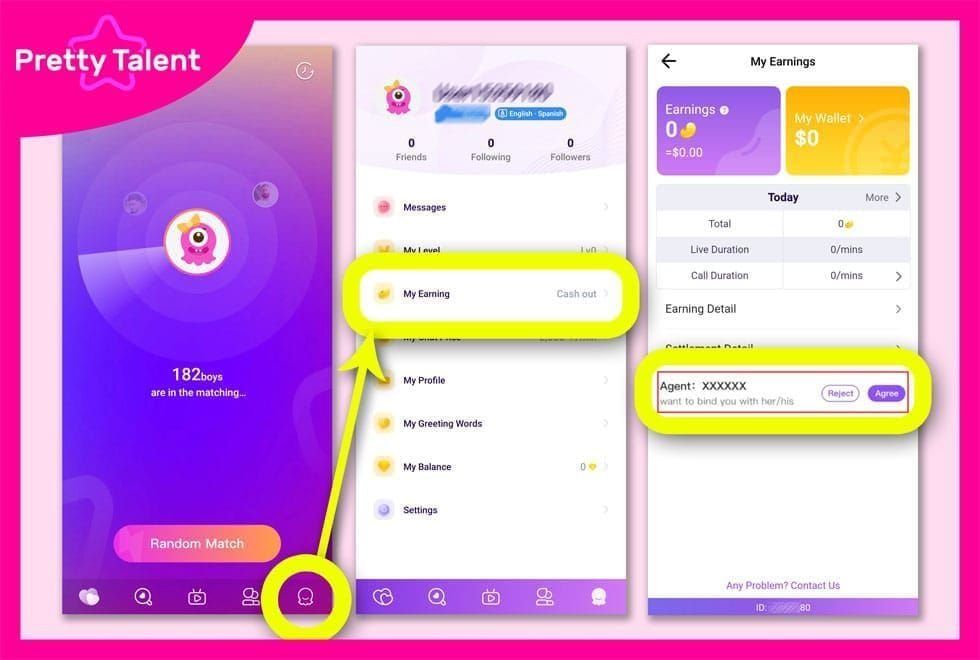
Manage daily operations
Access real-time revenue charts, member lists, earnings breakdowns
Send invitation links
Bind MetWallet accounts (minimum $10 withdrawal)
Troubleshoot payment issues, face verification, compliance
2025 Commission Structure
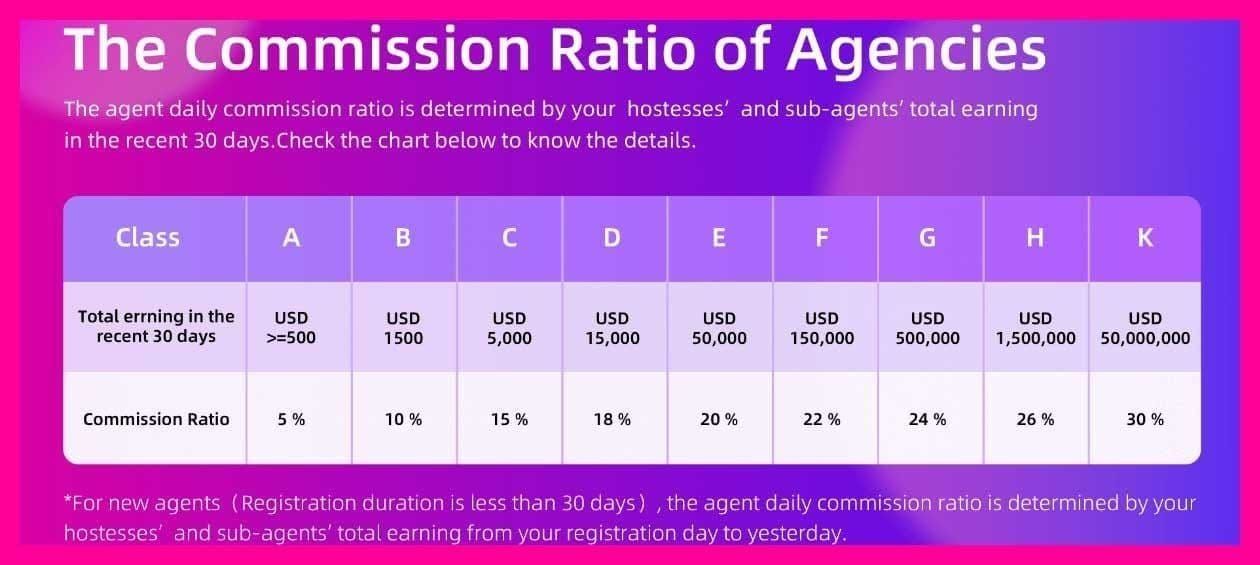
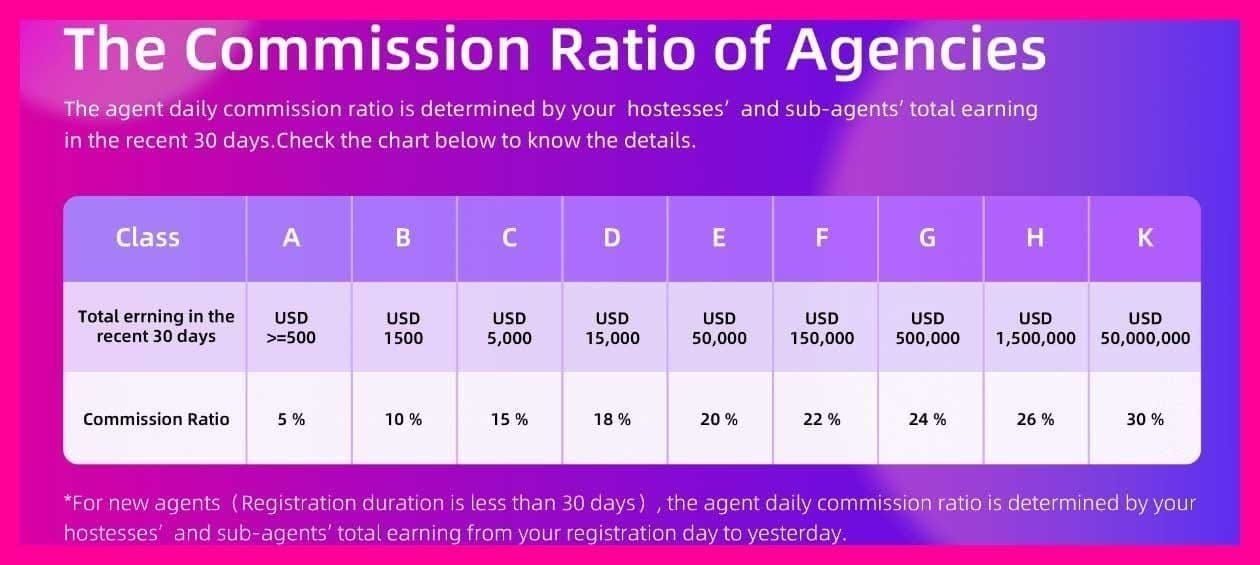
Nine revenue brackets with progressive rates:
$500–$1,499: 5%
$1,500–$4,999: 10%
$5,000–$14,999: 15% (minimum viable sub-agent level)
$15,000–$49,999: 18%
$50,000–$149,999: 20%
$150,000–$499,999: 22%
$500,000–$1,499,999: 24%
$1,500,000–$49,999,999: 26%
$50,000,000+: 30%
Commissions calculate daily based on prior 30-day rolling team revenue. New agents (under 30 days) earn from registration day to yesterday. Payments process daily once revenue exceeds $500, depositing to MetWallet (10,000 Beans = $1 USD).
Sub-Agent Responsibilities
Recruitment lifecycle:
Initial outreach through onboarding
Access invitation links via Dashboard
Guide profile setup, verification, initial training
Daily operations:
Monitor Dashboard revenue charts
Identify underperformers
Conduct one-on-one coaching
Resolve technical issues
Maintain team morale
Balance personal broadcasting with management
Financial management: Override earnings: (agent ratio – sub-agent ratio) × sub-agent daily revenue Direct host commissions: agent ratio × hostess daily cashable amount
Example: 24% agent with 20% sub-agent earns 4% override; 20% agency with 15% sub-agent captures 5% override.
2025 Commission Threshold Benchmarks
$5,000 monthly revenue = mathematical breakpoint for sustainable team systems. At 15% commission, generates $750 monthly—sufficient margin for sub-agent overrides. Below this, 5-10% rates create insufficient spread.
Experienced agencies target $15,000–$20,000 range (18% commissions = $2,700–$3,600 monthly). This supports meaningful 3-5% overrides while promoted hosts maintain attractive earnings at 15%.
Consistency matters more than spikes. Evaluate candidates across 3-6 months for sustainable patterns vs. temporary peaks. Hosts showing 15-20% month-over-month growth with minimal volatility present lower risk.
Minimum Monthly Diamond Generation
Top-tier hosts consistently generate 50,000–100,000+ diamonds monthly ($5,000–$10,000+). Private video calls (1,200–12,000 Beans/minute) drive revenue. Example: 100 minutes daily at 6,000 Beans/minute = 600,000 Beans ($60) daily = $1,800 monthly from calls alone.
Track diamond velocity alongside absolute numbers. Hosts increasing monthly totals by 10-15% quarterly demonstrate growth trajectories supporting team expansion. Stagnant performers at $5,000 may struggle with added sub-agent responsibilities.
Consistent Performance Windows (3-6 Months)
30-day rolling calculations create inherent volatility. Host generating $8,000 (Jan), $12,000 (Feb), $4,000 (Mar) experiences dramatic swings despite $8,000 average.
Implement quarterly reviews tracking minimum, maximum, average monthly revenue across 90-180 days. Candidates should show:
Minimum monthly floors above $4,000
Averages consistently exceeding $6,000
60-70%+ viewer return rates
Team Size and Revenue Diversification
Optimal: 5-8 hosts balances oversight capacity with revenue diversification.
Ideal composition:
2-3 top performers: $5,000+ monthly
3-4 mid-tier: $2,000–$4,000
1-2 developing: building toward $1,000+
Total team revenue: $15,000–$25,000 for 18-20% commission tiers.
Geographic/timezone diversification extends 24-hour coverage, increasing team diamond generation 30-40% vs. concentrated teams.
Financial Analysis: Break-Even Calculations
Compare current host earnings vs. projected sub-agent override income minus management time costs.
Host earning $3,600 monthly at 18% on $20,000 revenue drops to $3,000 at 15% = $600 monthly reduction. Requires recruiting 3-4 hosts generating $5,000 each to recover through 3-5% overrides.
At 5% override: 4 hosts × $5,000 × 5% = $1,000 override income = net $400 monthly gain. But this ignores 15-25 hours monthly for recruitment, training, management.
Chamet live chat diamond recharge via BitTopup ensures team maintains broadcasting without payment delays during peak hours.
Break-Even Formula
(Current Host Earnings - Projected Sub-Agent Personal Earnings) ÷ Override % = Required New Team Revenue
Example: $3,600 at 18% drops to $3,000 at 15% = $600 gap ÷ 5% override = $12,000 new team revenue monthly.
Factor management time at $20-30/hour. If 20 hours monthly = $400-600 opportunity cost. True break-even: $1,000-1,200 monthly override income = $20,000-24,000 new team revenue at 5%.
Account for 3-4 month ramp-up before recruits reach $3,000+ monthly. Maintain 6-9 months financial reserves or pre-recruit while still standard host.
Commission Split Models
At $5,000 threshold (15%), promoting creates minimal override—both parties at same tier. You earn 0% override.
Optimal timing: Your agency at 18-20% ($15,000-$50,000 monthly), promoting hosts to 15%. Creates 3-5% override margins. Sub-agent managing $10,000 team at 15% earns $1,500; you capture $300-500 override.
Most profitable: 20-24% tier ($50,000-$500,000 monthly). Agencies at 22-24% promoting to 18-20% create 2-4% spreads on larger bases. Sub-agent generating $100,000 at 20% earns $20,000; parent captures $2,000-4,000 override.
Hidden Costs
Training time: 8-12 hours initial onboarding + 2-4 hours monthly per member = 10-20 hours for 5-host team.
Technical support: 5-10 requests weekly, 15-45 minutes each.
Recruitment costs: $100-200 per successfully onboarded host (advertising + time). 20-30% annual turnover = ongoing expenses.
ROI Timeline by Team Size
Small (3-5 hosts): Break-even 4-6 months. Override income: $600-1,250 monthly at 5%.
Medium (6-8 hosts): Break-even 6-9 months. Override income: $1,500-2,500 monthly.
Large (10+ hosts): Break-even 9-12 months. Override income: $3,000-5,000+ monthly. Requires assistant managers or automation.
Host Readiness: 7 Critical Criteria
Performance consistency: Less than 20% month-over-month variance over 6+ months
Leadership aptitude: Naturally mentors teammates, shares strategies, organizes events
Technical mastery: Troubleshoots own issues, navigates Dashboard, explains commission mechanics
Peak hour reliability: 85-90%+ attendance during committed peak hours over 90 days
Revenue efficiency: $40-60+ per broadcasting hour
Communication effectiveness: 90%+ response rate to inquiries within 24 hours
Analytics interpretation: Reviews Dashboard regularly, identifies trends, makes data-driven decisions
Performance Consistency
Monitor:
Revenue per broadcasting hour
Seasonal performance patterns
Viewer return rates (60%+ target)
Average session duration (25-35+ minutes)
Gift-giving frequency (15-25 regular supporters)
Leadership and Communication
Evaluate:
Response times to messages
Conflict resolution without moderator intervention
Collaborative behaviors in team settings
Training aptitude (can teach skills to others)
Celebration of teammates' achievements
Technical Knowledge
Candidates should:
Explain 30-day rolling revenue calculation
Describe MetWallet binding process from memory
Navigate Dashboard sections without guidance
Propose systematic troubleshooting approaches
Interpret analytics and correlate with actions
Step-by-Step Promotion Framework
Phase 1: Data Collection (Months 1-3)
Track daily diamonds, broadcasting hours, unique viewers, return rates, revenue/hour
Conduct monthly structured reviews using standardized forms (1-5 scale)
Gather 360-degree feedback from teammates
Document specific behavioral examples
Phase 2: Trial Leadership (Months 4-5)
Assign mentorship of 1-2 new hosts
Delegate team tasks (scheduling, reports, meetings)
Monitor personal performance (should maintain 85-90% baseline revenue)
Evaluate training effectiveness through new host metrics
Phase 3: Financial Modeling
Build projections with:
4-month ramp-up assumption
25% annual turnover
20 hours monthly management at $25/hour
Three scenarios (pessimistic, realistic, optimistic)
Negotiate:
Override percentages
Support expectations
Performance benchmarks
Status review timelines
Revocation conditions
Phase 4: Official Promotion
Send sub-agent invitation via Dashboard
Guide acceptance process
Verify status change in Member List
Conduct comprehensive onboarding (Dashboard, recruitment, training, monitoring)
Provide templates (ads, checklists, materials)
Schedule weekly check-ins (first month)
Common Mistakes
1. Promoting Based on Friendship
Implement blind evaluations with numerical scoring. Require minimum threshold scores (e.g., 28/35) for eligibility.
2. Underestimating Training Time
Provide 15-20 hours initial training + ongoing support:
Weekly calls (month 1)
Bi-weekly (months 2-3)
Monthly (months 4-6)
Create documentation: templates, guides, checklists, flowcharts.
3. Ignoring Market Saturation
Implement territory management by:
Geographic regions
Language markets
Content niches
Monitor: declining revenue/host, increasing acquisition costs, lengthening time-to-productivity.
4. Poor Contract Terms
Include:
12-24 month non-solicitation periods
Exact override calculation formulas
Performance benchmarks with review timelines
Status revocation procedures
Post-Promotion Strategy
First 90 Days Action Plan
Days 1-7: Recruitment infrastructure
Create ads highlighting earnings, flexibility, training
Identify channels (social media, job boards, networks)
Target: 15-20 inquiries → 5-8 qualified candidates
Days 8-30: Interviews and selections
Structured interviews with scoring rubrics
Select 2-3 top candidates + 1-2 backups
Days 31-60: Onboarding and training
Account creation, face verification, MetWallet binding
3-4 training sessions on broadcasting, engagement, monetization
Monitor first 10-15 broadcasts with real-time feedback
Days 61-90: Performance optimization
Analyze data, identify improvements
Implement coaching schedules (weekly → bi-weekly)
Calculate actual vs. projected override earnings
Document lessons learned
Ongoing Training Programs
Monthly sessions rotating topics:
Analytics interpretation
Team motivation/retention
Conflict resolution
Strategic planning
Peer learning groups: 3-5 sub-agents, monthly virtual meetings, rotating leadership.
External resources: Platform webinars, conferences, courses. Budget: $100-200 quarterly per sub-agent.
Quarterly Performance Reviews
Five key metrics:
Total team revenue (target: 15%+ quarterly growth)
Host retention (target: 70%+)
Time-to-productivity (target: under 75 days to $2,000 monthly)
Personal performance maintenance (target: 85%+ of pre-promotion earnings)
Override income (actual vs. projected)
Tier adjustments:
Top performers (4/5 benchmarks): recognition, potential increased overrides (6-7%)
Underperformers (fewer than 3/5 for two quarters): performance improvement plan or status revocation
FAQ
What's the minimum monthly revenue for promoting to sub-agent? $5,000 activates 15% tier (minimum viable), but optimal timing is $15,000-$20,000 (18% tier) where 3-5% override spreads generate meaningful income.
How much do sub-agents earn vs. regular hosts? Dual income: personal commission rate (typically 15% when promoted) on own broadcasting + override (parent rate - sub-agent rate) × team revenue. Example: 20% parent with 15% sub-agent earns 5% override on all sub-agent team production.
What are risks of promoting too early? Personal earnings decline (18% to 15%) before override compensates, inadequate leadership causes poor team performance/high turnover, insufficient reserves force abandonment of team building.
How long until sub-agent team becomes profitable? Small teams (3-5 hosts): 4-6 months. Medium (6-8): 6-9 months. First 60 days minimal override, months 3-4 hosts reach $2,000-3,000, months 5-6 full productivity at $4,000-5,000.
What happens to existing earnings when becoming sub-agent? Commission rate typically drops from 18% to 15% on personal broadcasting, reducing immediate earnings. But gain override ability. Example: $3,600 at 18% drops to $3,000 at 15%, but 5% override on $15,000+ team generates $750+ additional income.
How many hosts should a sub-agent manage? Optimal: 5-8 hosts. Ideal mix: 2-3 top ($5,000+), 3-4 mid-tier ($2,000-4,000), 1-2 developing ($1,000+).
Ready to scale your Chamet agency? Ensure uninterrupted broadcasting with BitTopup's instant diamond recharge—24/7 support, competitive pricing, secure transactions. Visit BitTopup for exclusive agency bulk rates and premium service supporting your team's growth.