

Poppo Live sub-agents with 10 hosts earn $140 recruitment bonuses plus $300-1,000 monthly in the first three months, depending on host performance and commission tiers. Elite teams scale beyond $10,000 monthly through strategic tier advancement and split optimization.
Understanding the Poppo Live Sub-Agent Commission Model
Sub-agents operate under parent agencies in a three-layer profit structure: platform retention, parent agency commission, and sub-agent earnings. Every 10,000 points equals $1 USD. Hosts retain 70% of live/party gift points, 40% from match/chat interactions.
When viewers send 10,000 coin gifts, hosts receive 7,000 points ($0.70). Sub-agents earn commissions on these host points through video/voice chats (1,400-4,200 points/minute) and PK battles (~1,000 points per 30-minute session).
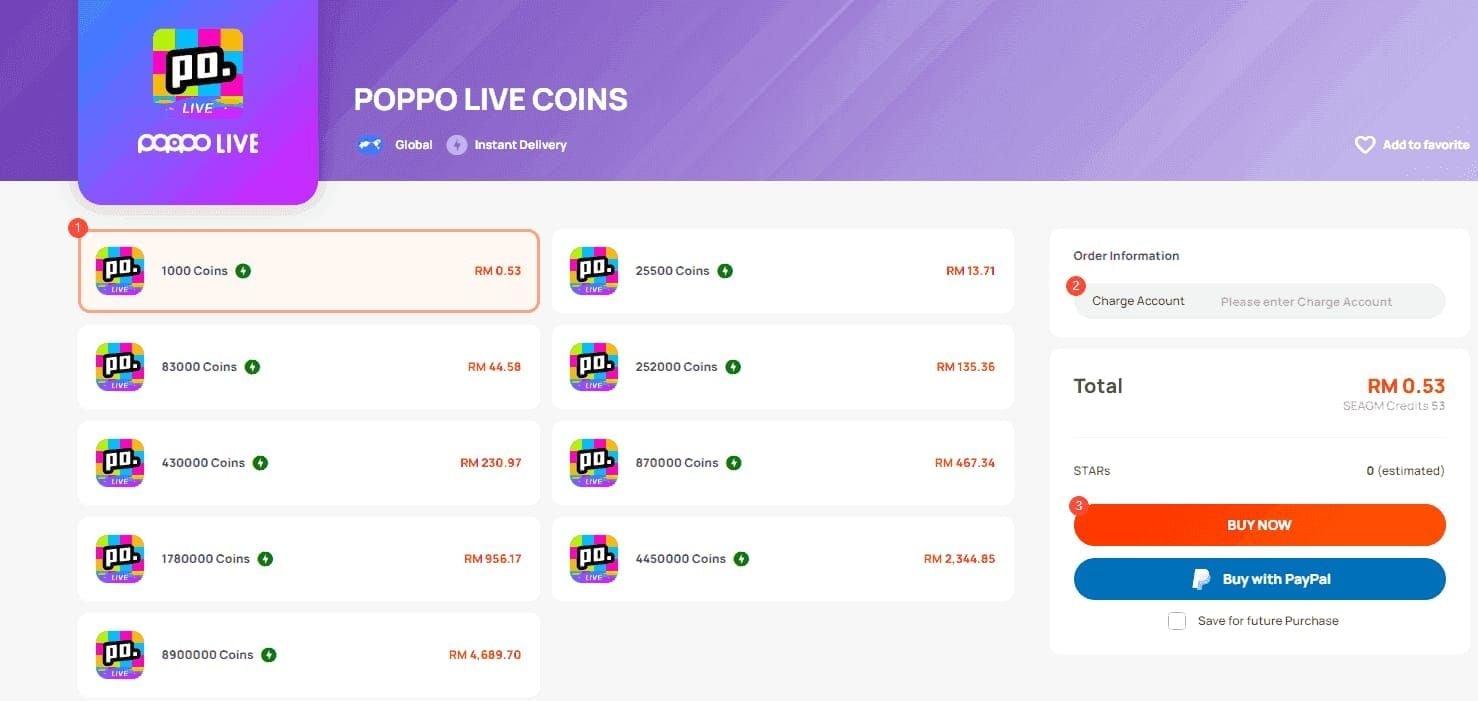
For gift engagement support, Poppo Live Coins recharge through BitTopup offers competitive rates and instant delivery.
Sub-Agent vs Official Agent
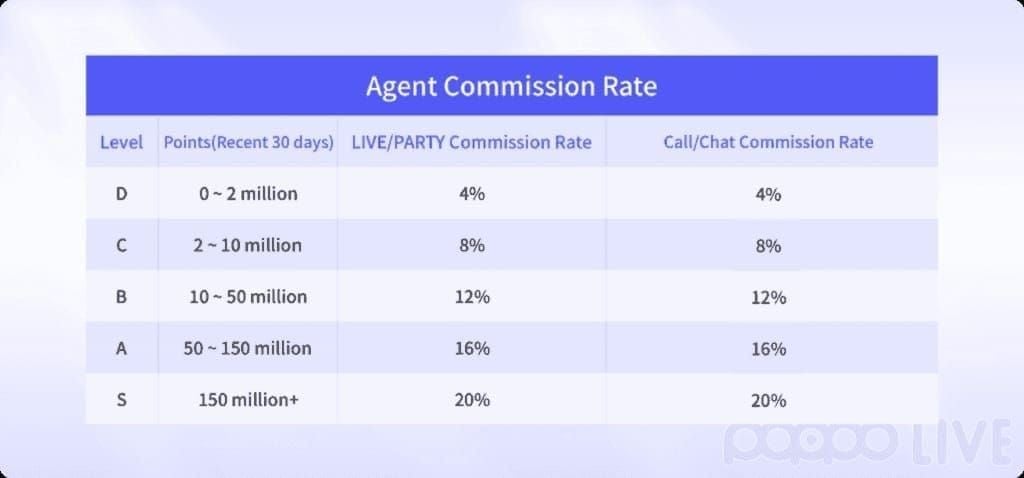
Official agents operate directly under Poppo Live with full tier access:
D-tier: 4% live/party, 30% match/chat (0-2M points)
C-tier: 8% live/party, 35% match/chat (2-10M points)
B-tier: 12% live/party, 40% match/chat (10-50M points)
A-tier: 16% live/party, 45% match/chat (50-150M points)
S-tier: 20% live/party, 50% match/chat (150M+ points)
Sub-agents receive splits from parent agencies, not direct platform payouts. Both require: age 18+, face verification, Level 5 account, 1 Mbps upload speed (mandatory since Sept 28, 2025), app version 2.9.6+, iOS 12.0+ or Android 5.0+.
Three-Tier Revenue Split System
Revenue flows: Platform retention → Parent agency commission → Sub-agent split.
Sub-agents earn from parent's commission, not gross revenue. A sub-agent under B-tier parent (12% live commission) with 50% split earns effective 6% rate. Same sub-agent under S-tier parent (20% live) earns effective 10%—five times better despite identical split.
2026 Policy Changes
Five-tier system maintained with stricter requirements:
5+ active hosts minimum
Each streaming 1+ hour daily
10 hours weekly collective minimum
1 Mbps upload speed mandatory
Face cam required for 1+ hour sessions
Peak windows (7-11 PM weekends) yield 200-300% higher engagement. Non-compliance triggers suspension after two weeks.
Why 10 Hosts Matter
10-host threshold provides:
$140 recruitment bonus ($14 per verified host)
Sustainable monthly income vs one-time bonuses
100% buffer above 5-host minimum
Manageable personalized attention
Philippines market data: 20-host teams reach $1,800-3,600 monthly by month three at 15% commission. Proportionally, 10-host teams generate $900-1,800 monthly, or $150-500 during ramp-up.
Split Ratio Mechanics: Commission Percentages
Two parallel tracks: live/party (4-20% by tier, high volume) and match/chat (30-50% by tier, premium rates).
Example calculation: S-tier parent earning 20% live gifts assigns sub-agent 12% rate (B-tier equivalent), retains 8% differential. On host generating 10M points monthly ($1,000), parent keeps $80, sub-agent receives $120.
Platform's Base Revenue Share
Platform retention occurs before agency commissions. Global rates: ~9,460 coins/$1. Philippines: 12,000+ coins/$1. Agency rates: 92,000-95,000 coins/$10.
Host retention (70% live, 40% match) represents post-platform share. 10,000 coin gift → host receives 7,000 points ($0.70). Agency commissions apply to reduced host earnings, not gross viewer spending.
Official Agent Commission Layer
Official agents earn tier percentages directly from host points. B-tier agent (10-50M monthly points) receives 12% live/party, 40% match/chat after host retention.
Advancing D-tier (4% live) to C-tier (8% live) doubles commission. S-tier (20% live, 50% match) provides 5x D-tier live rate, 67% higher match rate.
Minimum withdrawal: $10 (100,000 points), processed Sundays 23:59 UTC+8, 1-3 day crypto settlement.
Sub-Agent Split Ranges
Typical splits: 40-60% of parent's commission. 50% represents equilibrium.
Concrete example: Parent earns $1,000 monthly from sub-agent's 10-host team. 50% split = $500 sub-agent, $500 parent passive income.
Lower splits (30-40%): Parent provides substantial support. Higher splits (60-70%): Competitive recruitment markets. New sub-agents expect 40-50% initially.
Performance Tiers Impact
Sub-agents don't access tiers directly—parent's tier determines effective rates.
50% split under D-tier parent (4% live) = 2% effective rate
50% split under S-tier parent (20% live) = 10% effective rate
40% split of 20% S-tier (8% effective) beats 60% split of 4% D-tier (2.4% effective). Prioritize high-tier parent agencies.
Calculating Profit from 10 Hosts
Four steps: host point generation → multi-layer splits → operational costs → net monthly profit.
D-tier host (4-6 hours daily): 0-2M points monthly ($50-200). Ten D-tier hosts: 0-20M points ($500-2,000 host earnings). C-tier Philippines hosts: 2-10M points individually ($1,800-3,600 monthly).
For strategic gift support, buy Poppo Live Coins via BitTopup for secure transactions and competitive pricing.
Step 1: Host Diamond Generation
Moderately successful host (3 hours daily): 50,000-100,000 coins daily ($5.29-10.58). At 70% retention: 35,000-70,000 points daily ($3.50-7.00), or 1.05-2.1M points monthly ($105-210).
Ten hosts at this level: 10.5-21M collective points monthly ($1,050-2,100 host earnings). C-tier territory.
Peak 7-11 PM weekend slots with face cam: 200-300% multipliers. Host earning $7 daily standard might generate $14-21 peak.
Step 2: Multi-Layer Split Calculation
Scenario: 10-host team generates 15M points monthly ($1,500 host earnings). 80% live (12M points, $1,200), 20% match (3M points, $300).
B-tier parent (12% live, 40% match):
Live commission: 12M × 12% = 1.44M points ($144)
Match commission: 3M × 40% = 1.2M points ($120)
Total parent: 2.64M points ($264)
Sub-agent 50% split: $132 monthly
Sub-agent 60% split: $158.40
Sub-agent 40% split: $105.60
S-tier parent (20% live, 50% match):
Live commission: 12M × 20% = 2.4M points ($240)
Match commission: 3M × 50% = 1.5M points ($150)
Total parent: 3.9M points ($390)
Sub-agent 50% split: $195 monthly (48% higher than B-tier)
Step 3: Costs and Deductions
Operational costs:
Host incentives: 15-25% of commission (competitive retention requirement)
Training resources: $50-200 development, $4.17-16.67 monthly amortized
Communication tools: $10-30 monthly (Discord, scheduling, analytics)
Strategic diamond recharges: $20-50 monthly for engagement support
Example: $195 gross monthly
Host incentives (20%): -$39
Tools: -$15
Diamond support: -$30
Net profit: $111
Step 4: Monthly Net Profit Projections
Conservative (10 D-tier hosts, $100 avg, B-tier parent, 50% split):
Gross: $1,000 × 12% × 50% = $60
Incentives (20%): -$12
Costs: -$20
Net: $28
Moderate (10 C-tier hosts, $200 avg, A-tier parent, 50% split):
Gross: $2,000 × 16% × 50% = $160
Incentives (20%): -$32
Costs: -$25
Net: $103
Optimistic (10 mixed hosts, $300 avg, S-tier parent, 55% split):
Gross: $3,000 × 20% × 55% = $330
Incentives (20%): -$66
Costs: -$30
Net: $234
Aligns with stated $300-1,000 for 20-host teams, suggesting 10-host teams earn $150-500 monthly.
Real Earnings Scenarios
All scenarios: 50% split, A-tier parent (16% live, 45% match), 70/30 live/match split.
Low-Performance: Part-Time Hosts (10-20 Hours/Week)
Part-time hosts (1.4-2.9 hours daily): 500K-1.5M points monthly ($50-150 per host). Ten hosts: 5-15M points ($500-1,500 total).
$1,000 total host earnings (70% live = $700, 30% match = $300):
Live: $700 × 16% = $112
Match: $300 × 45% = $135
Parent total: $247
Sub-agent gross (50%): $123.50
Incentives (15%): -$18.53
Costs: -$20
Net: $84.97
Represents lower boundary. $85 monthly with 10-15 hours weekly = $5.67-8.50 hourly equivalent.
Medium-Performance: Committed Hosts (30-40 Hours/Week)
Committed hosts (4.3-5.7 hours daily): $200-400 monthly in typical markets.
Ten hosts averaging $250 = $2,500 total (70% live = $1,750, 30% match = $750):
Live: $1,750 × 16% = $280
Match: $750 × 45% = $337.50
Parent total: $617.50
Sub-agent gross (50%): $308.75
Incentives (20%): -$61.75
Costs: -$25
Net: $222
Mid-range scenario. $222 monthly with 15-20 hours weekly = $11.10-14.80 hourly equivalent.
High-Performance: Top-Tier Hosts (50+ Hours/Week)
Mixed team: 3 high performers ($800 avg) + 7 solid performers ($300 avg).
Total: (3 × $800) + (7 × $300) = $4,500 (70% live = $3,150, 30% match = $1,350):
Live: $3,150 × 16% = $504
Match: $1,350 × 45% = $607.50
Parent total: $1,111.50
Sub-agent gross (50%): $555.75
Incentives (25%): -$138.94
Costs: -$40
Net: $376.81
Upper boundary. $377 monthly with 20-25 hours weekly = $15.08-18.85 hourly equivalent.
Mixed Team: Realistic Expectations
4 part-time ($100 avg) + 4 committed ($250 avg) + 2 high performers ($500 avg).
Total: $400 + $1,000 + $1,000 = $2,400 (70% live = $1,680, 30% match = $720):
Live: $1,680 × 16% = $268.80
Match: $720 × 45% = $324
Parent total: $592.80
Sub-agent gross (50%): $296.40
Incentives (20%): -$59.28
Costs: -$25
Net: $212.12
Realistic scenario: $212 monthly. With $140 recruitment bonus, first-month total ~$352.
Factors Impacting Commission
Host Streaming Consistency
Five-host minimum: each 1+ hour daily, 10 hours weekly collective. Commission growth requires exceeding minimums.
Hosts streaming 4-6 hours daily: C-tier range ($1,800-3,600 Philippines markets). 2-3 hours daily: D-tier ($50-200).
Ten hosts × 4 hours daily = 40 collective daily hours, 1,200 monthly hours. At 50,000 points/hour: 60M monthly points ($6,000). Even D-tier rates (4% live, 30% match) generate significant revenue.
Consistency affects algorithms. Regular schedules receive preferential discovery placement. Irregular patterns reduce promotion, requiring audience rebuilding.
Viewer Engagement and Gift Frequency
Engaged viewer hours > raw streaming hours. Host with 5 active gifters outperforms host with 50 passive viewers.
Hosts actively encouraging gifting (callouts, thank-yous, gift-triggered interactions) generate 150-250% more points per viewer than passive hosts.
Match/chat revenue depends on transitioning public viewers to private sessions. Skilled hosts shift revenue mix from 70/30 live/match to 50/50 or 40/60, dramatically increasing commission (30-50% match rates vs 4-20% live rates).
Seasonal Fluctuations
Holiday periods (December, Chinese New Year, Valentine's Day): 200-400% increased gifting. Summer months: 20-30% declines.
Platform events create temporary multipliers. Special promotions might offer double points or bonus payouts. Sub-agents coordinating host participation generate 150-200% baseline monthly earnings during event weeks.
Long-term planning requires averaging peaks/valleys. $300 December, $180 July = $240 annual average. Budget on conservative averages, not peak performance.
Parent Agency Relationship
Parent relationship determines splits, support quality, advancement opportunities. Agencies prioritizing sub-agent success provide training, tools, responsive problem-solving.
Negotiation leverage increases with performance. Sub-agent managing 10 active hosts with low attrition negotiates split increases from 50% to 55-60% after 6-12 months.
Some parents offer tier-based progression: sub-agents managing 20+ hosts receive official agency status, converting from splits to direct platform commissions.
Hidden Costs Reducing Net Profit
Successful sub-agents allocate 30-50% gross commissions to incentives, tools, support. These investments improve retention but reduce take-home profit.
Host Incentive Programs
Competitive incentives add 15-30% to base platform earnings. Host earning $200 monthly expects $30-60 agency bonuses. Ten hosts consume $300-600 monthly from sub-agent commissions.
Common structures:
Consistency bonuses: $20-50 for 25+ streaming days
Performance tiers: $10-30 for point milestones (1M, 2M, 5M)
Recruitment rewards: $5-15 for referring new hosts
Retention bonuses: $50-100 for 3, 6, 12-month anniversaries
Sub-agent earning $300 gross allocating $150 incentives retains $150 before other costs. But hosts receiving competitive incentives show 60-80% lower attrition.
Training Resources
Quality onboarding reduces time-to-productivity. Comprehensive training enables C-tier performance in 4-8 weeks vs 12-16 weeks trial-and-error.
Options:
Video tutorials: $100-300 one-time, reusable indefinitely
Written guides: $50-150 professional copywriting
Live onboarding: 2-3 hours per host at $20-30 hourly opportunity cost
Ongoing coaching: 1-2 hours weekly at $20-30 hourly
Amortizing $500 training over 12 months = $41.67 monthly. Hosts with structured training reach profitability 4-6 weeks faster, generating additional $200-400 first year—400-800% ROI.
Communication Tools
Professional tools:
Discord/Telegram: Free to $10 monthly
Scheduling tools: $10-20 monthly
Analytics dashboards: $15-30 monthly
Payment processing: $5-10 monthly
Total: $30-70 monthly. Free alternatives sacrifice efficiency. Sub-agent spending 5 additional hours monthly on manual processes loses $50-75 opportunity cost at $10-15 hourly rates.
Diamond Recharge Support
Strategic recharges serve multiple purposes: demonstrating gifting mechanics, maintaining engagement during slow periods, rewarding performance. Allocate $30-50 monthly.
BitTopup offers competitive rates (92,000-95,000 coins/$10 for agencies) with instant delivery. $30 monthly = 276,000-285,000 coins for:
New host demos: 50,000 coins (5-6 moderate gifts)
Slow period support: 100,000 coins across struggling hosts
Performance rewards: 150,000 coins for top monthly performer
$30 investment preventing one host departure saves $140 lost recruitment bonus plus $20-50 monthly ongoing commissions.
Payment Schedules and Withdrawal
Commission settlements: weekly or monthly cycles. Poppo Live processes official agency withdrawals Sundays 23:59 UTC+8, 1-3 day crypto transfers. Sub-agents receive payments from parents on similar schedules.
Minimum withdrawal: $10 (100,000 points). Sub-agents earning $212 monthly withdraw full amount. Those earning $85 might accumulate two months to reach $170, avoiding multiple transaction fees.
Monthly Settlement Cycles
Most parents calculate sub-agent commissions on calendar month performance (1st through last day). Settlement occurs 5-10 days into following month.
30-day team point calculation for tier determination creates timing mismatches. Sub-agent's hosts generate 15M points January (C-tier performance), but if parent's broader team only generated 8M total, parent remains D-tier with lower commission rates.
Some agencies offer weekly advance payments at 80-90% estimated commission with monthly reconciliation. Provides consistent cash flow but introduces complexity if performance falls short.
Minimum Thresholds and Processing
$10 minimum (100,000 points) = ~3-4 weeks earnings for low-performing sub-agents. Higher performers ($200+ monthly) easily exceed thresholds. Those earning $50-100 prefer monthly accumulation.
Crypto withdrawal: 1-3 days from parent initiation. Account for delay when planning time-sensitive expenses. Alternative methods (PayPal, bank transfer, mobile money) have different processing times and fees.
Transaction fees vary by method/amount. Crypto transfers: $1-5 regardless of amount. Sub-agent withdrawing $50 monthly pays 2-10% fees. Withdrawing $200 monthly pays 0.5-2.5%—compelling argument for scaling beyond 10 hosts.
Payment Methods 2026
Crypto primary method: Bitcoin, USDT, Ethereum. International accessibility, lower fees. Sub-agents manage exchange rate volatility and local currency conversion.
Regional methods:
Philippines: GCash, PayMaya, bank transfer
Indonesia: OVO, GoPay, bank transfer
Vietnam: MoMo, ZaloPay, bank transfer
Global: PayPal, Payoneer, Wise
Compare total costs including withdrawal fees, currency conversion, local cash-out. $200 withdrawal might net $195 via crypto (2.5% total) vs $188 via PayPal (6% total).
Agency Dashboard Tracking
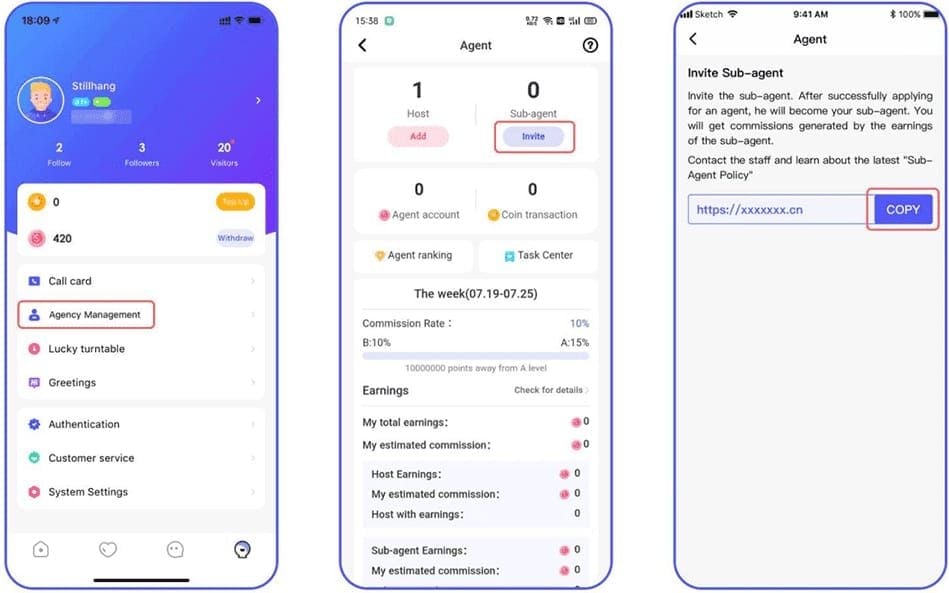
Parent agencies provide dashboards showing:
Individual host points: daily/monthly totals per host
Revenue breakdown: live/party vs match/chat percentages
Commission calculations: transparent tier rates and split percentages
Payment history: all withdrawals and pending settlements
Verify dashboard figures against manual calculations monthly. Discrepancies occur from point adjustments, chargebacks, system errors. Early detection prevents accumulated losses.
Advanced dashboards offer predictive analytics. Sub-agent tracking $150 by mid-month projects $300 monthly total, enabling proactive coaching to reach $350+ through targeted engagement final two weeks.
Common Misconceptions
Myth: 10 Hosts = Automatic Income
Recruitment is beginning, not end. $140 recruitment bonus provides one-time income. Sustainable monthly commissions require hosts remaining active, engaged, productive.
Industry attrition: 60-70% unsupported hosts within first three months. Sub-agent recruiting 10 hosts without ongoing support might retain only 3-4 by month four, falling below 5-host minimum, facing suspension.
Effective sub-agents treat recruitment as first step in multi-month onboarding/development. Real work begins after recruitment: teaching mechanics, troubleshooting issues, coaching engagement, maintaining motivation.
Reality: Active Management Required
Consistent earnings require consistent host performance, demanding active involvement.
Structured management:
Weekly check-ins: 15-30 min calls per host reviewing performance, addressing concerns, setting goals
Daily monitoring: dashboard metrics identifying struggling hosts requiring intervention
Monthly reviews: formal assessment with incentive distribution
Ongoing training: sharing techniques, platform updates, competitive intelligence
10-15 hours weekly for 10 hosts = ~1-1.5 hours per host monthly. Sub-agents earning $212 monthly effectively earn $13.25-21.20 per management hour—competitive with remote work but not passive.
Leverage comes from scalability. 20 hosts require 18-20 hours weekly (not double). 30 hosts might require 25-28 hours. Per-host time decreases as systems mature.
Retention Challenge
Host retention determines long-term viability. Replacing departed hosts costs $14 lost recruitment bonus plus 5-10 hours recruitment/onboarding. Sub-agent with 50% annual attrition (5 of 10 departing) spends $70 and 25-50 hours on replacement.
Retention strategies:
Competitive incentives: matching/exceeding market-rate bonuses
Recognition systems: public acknowledgment of top performers
Community building: peer support networks
Career development: pathways to higher earnings
Responsive support: addressing issues within 24 hours
Sub-agents maintaining 80-90% annual retention (losing 1-2 hosts yearly) operate far more profitably than 50-60% retention. Difference between replacing 1 vs 5 hosts annually = $56 recruitment costs plus 20-40 hours effort—equivalent to $200-400 opportunity cost.
Why Sub-Agents Fail Despite 10+ Hosts
Common patterns:
Inadequate selection: Recruiting quantity over quality. Ten poorly-selected hosts generate less than five well-selected hosts while requiring more management.
Insufficient training: Minimal onboarding expecting self-education. Hosts lacking training take 2-3x longer to reach productivity, if ever.
Poor communication: Irregular check-ins, slow responses, lack of proactive coaching. Unsupported hosts migrate to attentive agencies.
Unrealistic expectations: Projecting maximum-case earnings ($500+ from 10 hosts) then becoming discouraged at $150-250 reality. Disappointment reduces effort, creating self-fulfilling failure.
Inadequate financial planning: Failing to account for incentives, expenses, seasonal fluctuations. Budgeting on gross vs net profit creates cash flow problems.
Scaling Beyond 10 Hosts
10-host benchmark provides proof-of-concept and management experience. Substantial income requires expansion to 20-50+ hosts. Scale after demonstrating success at current capacity.
Optimal scaling: current hosts show stable performance, retention >80% annually, available time capacity. Managing 20 hosts while struggling with 10 degrades quality across entire team.
Right Time to Recruit More
Quantitative indicators:
Retention rate: ≥80% hosts active 3+ months
Performance stability: average host earnings varying <20% month-to-month
Time availability: current management <15 hours weekly, leaving 5-10 hours for expansion
Financial buffer: 2-3 months operational costs saved for new host incentives during ramp-up
Qualitative indicators:
System maturity: documented processes for onboarding, training, performance management
Host satisfaction: positive feedback, minimal complaints
Problem-solving efficiency: resolving typical issues within 24 hours
Personal confidence: comfortable with current operations vs overwhelmed
Sub-agents meeting criteria expand to 15-20 hosts with minimal risk. Those lacking foundations should optimize current operations before scaling.
Management Capacity
Management capacity follows diminishing returns. First 10 hosts require intensive individual attention as sub-agent develops systems. Hosts 11-20 benefit from mature processes, reducing per-host time. Hosts 21-30 might require team leaders or tiered support.
Quality degradation warning signs:
Response time increases: 48+ hours addressing host questions
Reduced check-in frequency: skipping weekly calls or rushed 5-min sessions
Performance monitoring gaps: failing to notice struggling hosts until departure
Generic communication: identical messages vs personalized coaching
Maintaining quality while scaling:
Standardized onboarding: automated email series, video tutorials, checklists
Tiered support: experienced hosts mentoring newcomers
Performance dashboards: automated alerts for hosts below thresholds
Template libraries: pre-written responses to common questions, customized individually
Commission Growth Curves
Assuming $200 average per-host earnings, 50% split, A-tier parent (16% live/45% match):
10 hosts: $2,000 total → $296 gross → $212 net (after 20% incentives, $25 costs)
20 hosts: $4,000 total → $592 gross → $424 net (after 20% incentives, $40 costs)
50 hosts: $10,000 total → $1,480 gross → $1,036 net (after 20% incentives, $100 costs)
Linear scaling with slight efficiency improvements. However, managing 50 hosts often reduces average per-host earnings 10-20% due to diluted attention, suggesting actual 50-host net profit $830-930 vs $1,036.
BitTopup for Larger Teams
Larger teams enable sophisticated diamond strategies. Sub-agent managing 50 hosts might allocate $100-200 monthly:
New host starter packages: 50,000 coins per new host (5-6 monthly = 250,000-300,000 coins)
Performance competitions: 200,000 coin prize pool for top monthly performer
Team events: 300,000 coins during coordinated streams boosting all hosts
BitTopup's agency rates (92,000-95,000 coins/$10) make strategies cost-effective. $150 monthly = 1,380,000-1,425,000 coins for comprehensive team support while maintaining positive ROI through improved retention/performance.
Bulk recharge strategies provide negotiation leverage. Sub-agents demonstrating sophisticated support negotiate higher splits (55-60%) based on proven lower attrition and higher per-host performance.
Maximizing Earnings: Advanced Optimization
Beyond basic management, advanced sub-agents implement systematic optimization across recruitment, training, incentives, parent relationships. Strategies require upfront investment but generate 30-50% higher net profits.
Highest-leverage optimization: host selection criteria. Recruiting hosts with existing social media followings, content creation experience, or performance backgrounds reduces time-to-productivity from 8-12 weeks to 2-4 weeks. Accelerated revenue compounds over time.
Negotiating Better Splits
Split negotiation requires demonstrable value. Parents increase splits for sub-agents who:
Maintain low attrition: <20% annual vs 50-60% industry average
Generate high per-host performance: hosts averaging $250+ vs $150 market average
Recruit quality hosts: reaching C-tier within 2 months vs 4-6 month average
Require minimal support: self-sufficient operations reducing parent involvement
Negotiation timing: initial agreements offer 45-50% splits. After 6-12 months strong performance, request 55-60% splits. Emphasize mutual benefit: higher splits incentivize excellence while parent retains proven performer vs risking replacement recruitment.
Quantified proposals work best: My hosts average $280 monthly vs $180 agency average, generating 55% more commission. 55% split would recognize this performance while providing you 45% passive income from my efforts.
Host Performance Incentives
Sophisticated incentive structures align host behavior with sub-agent profit goals. Tiered systems reward specific outcomes vs flat bonuses:
Consistency tier:
20 days monthly: $10
25 days monthly: $25
28+ days monthly: $50
Performance tier:
1M points monthly: $15
2M points monthly: $35
5M points monthly: $100
Growth tier:
25% month-over-month increase: $20
50% increase: $50
100% increase: $100
Structures cost more during high-performance months but less during low-performance. Host earning $150 monthly receives $0-25 bonuses. Host earning $400 monthly receives $75-150—proportional to commission contribution.
Strategic Diamond Deployment
Advanced applications beyond simple gifting:
Competitive intelligence: Recharge to experience competitor hosts' rooms, analyze engagement techniques, adapt successful strategies.
New host confidence: Provide 30,000-50,000 coins for new hosts to experience receiving gifts, understand viewer psychology, practice thank-yous in low-pressure environments.
Performance rescue: Deploy 50,000-100,000 coins to hosts experiencing multi-week slumps, demonstrating support and preventing demoralization-driven departures.
Event coordination: Concentrate 200,000-300,000 coins during platform events or team competitions to maximize bonus multipliers and create memorable retention-improving experiences.
BitTopup's instant delivery enables time-sensitive strategies. Host messaging about slow night receives immediate 20,000 coin support, transforming potentially discouraging session into positive experience. Responsiveness builds loyalty, reduces attrition more effectively than larger delayed support.
Long-Term Sustainability
Sustainable operations prioritize retention over recruitment, quality over quantity, systems over individual effort. Short-term optimization maximizes current-month earnings; long-term optimization maximizes cumulative multi-year earnings.
Long-term strategies:
Host career development: Training on advanced techniques, connecting top performers with brand sponsorships, creating pathways to higher earnings keeping ambitious hosts engaged vs seeking external opportunities.
Community building: Facilitating peer connections through group chats, virtual meetups, collaborative events. Hosts with strong peer relationships demonstrate 40-60% higher retention than isolated hosts.
Financial planning support: Teaching hosts to manage irregular income, save for taxes, plan for platform volatility. Hosts with financial stability tolerate slow months better than paycheck-to-paycheck hosts.
Succession planning: Developing experienced hosts into assistant managers handling tier-one support, enabling sub-agent to scale beyond 50 hosts while maintaining quality.
Investments reduce short-term profit but create durable competitive advantages. Sub-agent earning $200 monthly with 90% retention outperforms one earning $250 monthly with 50% retention over any 12-month period due to reduced replacement costs and compounding team experience.
FAQ
How much do Poppo Live sub-agents earn from 10 hosts in 2026?
$150-500 monthly during initial three months, scaling to $200-400 monthly with established teams. Net profit depends on host performance, parent tier, split percentages, operational costs. Conservative scenarios with part-time hosts yield $85-150 monthly. Optimized teams with committed hosts generate $220-380 monthly after incentives and expenses.
What's the typical split ratio for Poppo Live sub-agents?
40-60% of parent's commission, with 50% most common. New sub-agents start 45-50%, with performance-based increases to 55-60% after demonstrating low attrition and high per-host earnings over 6-12 months. Split applies to parent's tier-based commission (4-20% live/party, 30-50% match/chat), not gross platform revenue.
How do you calculate sub-agent commission on Poppo Live?
Calculate total host points, multiply by parent's tier commission percentage (separately for live/party and match/chat), then multiply by negotiated split. Example: 10 hosts generating 15M points monthly ($1,500 host earnings), 80% live under A-tier parent (16% live) at 50% split yields: ($1,500 × 0.80 × 0.16 × 0.50) + ($1,500 × 0.20 × 0.45 × 0.50) = $96 + $67.50 = $163.50 gross before costs.
Is being a Poppo Live sub-agent profitable with only 10 hosts?
Depends on definition. Ten hosts generate $150-400 monthly net requiring 10-20 hours weekly management, equivalent to $7.50-20 hourly. Provides viable supplemental income but rarely replaces full-time employment. Profitability improves substantially scaling to 20-30 hosts, where operational efficiencies increase effective hourly rates to $15-30.
How often do Poppo Live sub-agents receive commission payments?
Depends on parent policies. Most process monthly settlements 5-10 days after month-end, mirroring Poppo Live's Sunday 23:59 UTC+8 withdrawal schedule. Some offer weekly advance payments at 80-90% estimated commission with monthly reconciliation. Minimum withdrawal $10 (100,000 points), 1-3 day processing for crypto transfers.
What factors affect sub-agent commission rates in 2026?
Parent tier status (D through S determining base percentages), negotiated split ratio (40-60% typical), host performance consistency (streaming hours and engagement), revenue source mix (live/party 4-20% vs match/chat 30-50%), seasonal fluctuations (200-400% holiday increases, 20-30% summer decreases), operational costs (incentives consuming 15-30% gross commission). Parent's total team performance determines tier, not just sub-agent's 10 hosts.
Ready to maximize sub-agent earnings? Power up host support with instant diamond recharges through BitTopup—the trusted platform for Poppo Live agents. Fast, secure, designed for professionals scaling teams. Visit BitTopup now and unlock your agency's full profit potential!