

Family Shields in Bigo Live provide critical last-second PK defense by pooling family gift contributions to counter snipe attacks. Success requires precise timing within the critical 5-second countdown window, coordinated family member activation, and understanding the 1-5 second processing latencies affecting 10-30% of defensive attempts.
Understanding Snipe Attacks in Bigo Live PK Battles
Snipe attacks are concentrated gift barrages during final seconds that reverse seemingly certain losses. Attackers hold 40-60% of planned gifts until the final stretch, exploiting psychological advantages when defenders relax their guard.
PK battles run 3-10 minutes, but the final 60-90 seconds determine outcomes in competitive matches. System latencies create the vulnerability—scoreboards reflect server state from 1-3 seconds prior, creating information gaps skilled snipers exploit.
Critical snipe windows cluster around specific countdown markers. The critical PK window spans from 5-second countdown to 3 seconds past zero, where gift processing still registers. Gifts sent at 2-second mark achieve 85-90% success rates, while 1-second attempts drop to 70% due to processing constraints.
Why Family Shields Matter for Competitive PK
Family Shields transform individual broadcaster vulnerability into collective defense. Through Family PK mode and gift pooling, families coordinate resources to counter concentrated attacks single broadcasters can't withstand. Top up Bigo Live Diamonds through BitTopup to maintain adequate bean reserves for shield activations with fast, secure transactions.
Multi-Guest streams supporting up to 12 broadcasters generate 60% viewer engagement boosts but attract more aggressive snipe attempts. Families with structured shield protocols convert this attention into defensive advantages.
Combat Points mechanics make shields essential. Each Bean from family gifts equals 1.0 Combat Point, while each Diamond sent also converts to 1.0 Combat Point. Shields leverage pooled point generation to create defensive barriers individual gift-sending can't match in speed or volume.
Complete Family Shield Mechanics Breakdown
Family Shields function as coordinated gift deployments from multiple members simultaneously, creating point surges that absorb or counter opponent snipes. Unlike regular gifts sent individually, shield activations pool family treasury resources into synchronized defensive barrages.
The system operates through Family PK mode, one of four primary PK formats alongside 1v1 Classic, Multi-Guest Room PK, and Event PKs. Family Battles feature gift pooling and brackets enabling collective resource deployment.
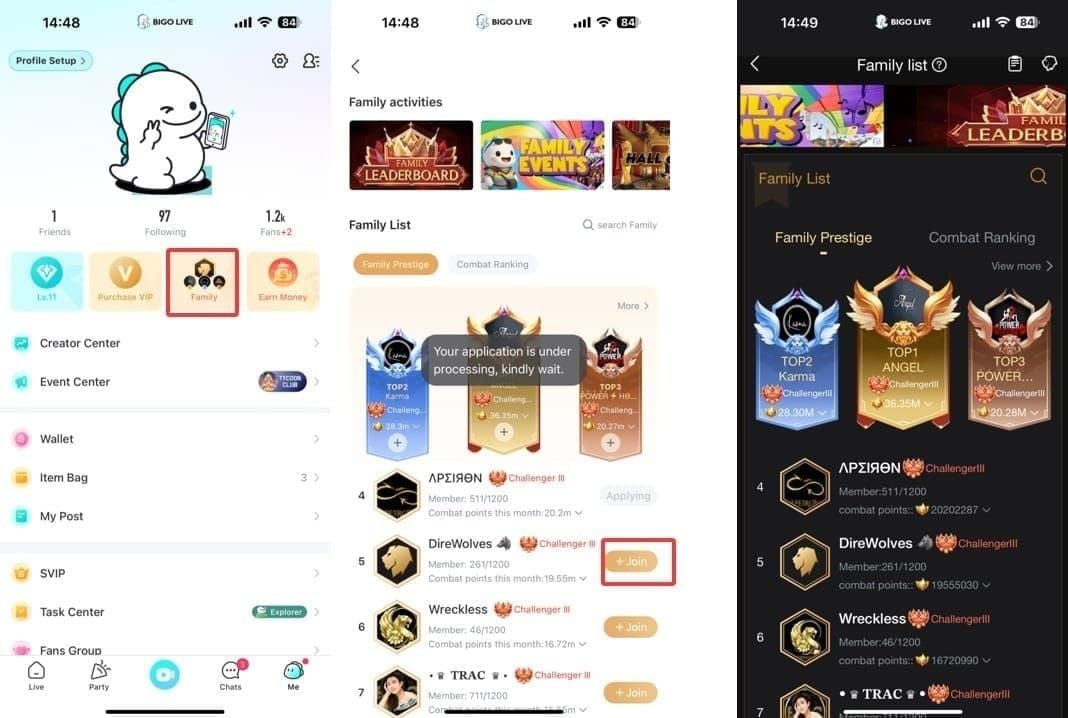
Shield effectiveness depends on family structure and member availability. Families require minimum 7 initial members from same region, with maximum capacity of 100 members. Co-founder and Deputy roles unlock at 50 members, providing additional coordination layers. Larger families distribute shield activation responsibilities across more members, reducing individual bean burden.
Processing mechanics determine shield success rates. Gift processing requires 1.5-2.5 seconds under optimal conditions, extending to 4-5 seconds during 7-11 PM peak hours when server loads increase. WiFi connections with 20-50ms latency achieve 85-90% PK success rates, while mobile connections at 60-100ms drop to 70-80% success.
Shield Duration and Coverage Scope
Shield deployments create temporary point generation surges rather than literal barriers. The shield metaphor describes defensive point accumulation countering incoming snipes through superior gift volume and timing.
Effective shield duration spans 3-8 seconds depending on coordination quality. Families with practiced protocols execute shields in 3-5 second bursts, concentrating maximum points within the critical countdown window. Less coordinated groups stretch activations across 6-8 seconds, diluting defensive impact.
Coverage extends to all family members participating in the PK battle. Multi-Guest configurations benefit most from shields, as the 60% engagement boost attracts larger opponent attacks requiring proportionally stronger defenses.
Optimal Shield Activation Timing Strategy

The critical 10-second defense window before PK conclusion represents the make-or-break period for shield deployment. Activating too early wastes resources on non-existent threats, while delayed activation fails to compensate for processing latencies.
Reading PK score gaps provides the primary trigger. When leading by 20-30%+ of total points with 15+ seconds remaining, shields remain unnecessary. As countdowns approach 10 seconds with leads narrowing below 15%, shield readiness becomes essential. Trailing positions at 10 seconds require aggressive shield deployment combined with offensive gift surges.
Early activation versus last-second deployment creates strategic tension. Shields activated at 8-10 seconds before conclusion provide maximum processing time buffers. However, premature activation allows opponents to calculate required snipe volumes and adjust attacks. Last-second deployments at 3-5 seconds maintain surprise but risk processing failures from latency spikes.
Gift animation delays add 0.5-1.5 seconds to actual point registration. The optimal window targets 5-7 seconds before conclusion, balancing processing reliability with tactical surprise.
Accounting for Network Lag Compensation
Network conditions directly impact shield effectiveness. WiFi connections provide the most reliable platform, with 20-50ms latency enabling 85-90% success rates. Mobile connections introduce 60-100ms latency reducing success to 70-80%, requiring earlier activation.
Peak hour considerations demand timing adjustments. The 7-11 PM window experiences 4-5 second processing delays versus 1.5-2.5 seconds during off-peak periods. Families conducting PKs during peak hours should activate shields at 8-10 seconds before conclusion rather than the standard 5-7 second window.
Test network conditions before critical PKs. Family members should verify connection quality through small test gifts 30-60 seconds before anticipated shield needs, observing registration speeds to calibrate activation timing. Consistent 2+ second delays signal need for earlier deployment.
Step-by-Step Family Shield Deployment Process
Successful shield deployment requires pre-PK coordination establishing clear roles and communication protocols. Designate 3-5 primary shield activators based on connection quality and bean availability, with 2-3 backup members ready.
Pre-PK Family Coordination Checklist:
Verify shield activators have adequate bean balances (minimum 500-1000 beans per member)
Confirm communication channel functionality (voice chat or messaging)
Establish shield trigger signals (leader call or predetermined score threshold)
Test network connections through small gift sends
Review opponent family strength and likely snipe patterns
Set backup activator sequence if primary members experience issues
Voice communication provides fastest coordination, enabling sub-second response times. Text-based coordination adds 2-4 second delays that may prove fatal. Establish standardized shield commands like SHIELD NOW or ACTIVATE that trigger immediate member response.
Manual Activation Procedure:

Monitor PK timer and score gap continuously during final 30 seconds
Leader announces shield readiness at 15-second mark
At designated trigger point (typically 5-7 seconds remaining), leader calls shield activation
All designated members simultaneously send predetermined gift amounts
Leader confirms point surge registration on scoreboard
Backup members deploy if initial surge proves insufficient
Successful shields generate visible point surges of 15-30% total score within 2-3 seconds of activation call. Delayed or absent surges indicate processing failures requiring immediate backup member deployment.
Emergency Response Protocols
Unexpected snipe attempts outside anticipated windows demand rapid shield adaptation. When opponents launch early snipes at 15-20 seconds remaining, families must decide between immediate counter-shields or absorbing attacks while preserving resources.
The decision matrix weighs score gap against remaining time. Early snipes creating 10%+ deficits with 15+ seconds remaining justify immediate shield responses. Smaller gaps below 5% allow families to hold shields for final-window deployment.
Processing failure responses require pre-designated backup sequences. If primary shield activators experience registration delays exceeding 3 seconds, backup members must deploy without waiting for leader confirmation.
Family Coordination for Maximum Defense Effectiveness
Assign shield roles based on connection quality, bean availability, and PK participation history. Top-tier shield activators should demonstrate consistent sub-2-second gift processing, maintain 1000+ bean reserves, and participate in 80%+ of family PKs.
Shield Role Hierarchy:
Primary Activators (3-5 members): Execute main shield deployments with largest gift amounts
Secondary Activators (2-3 members): Provide supplementary shield volume and backup coverage
Emergency Reserves (2-3 members): Deploy only when primary/secondary shields fail or prove insufficient
Observers (remaining members): Monitor opponent patterns and provide real-time intelligence
Three-tier activation sequences ensure shield deployment even when primary activators experience technical issues. Primary tier deploys at leader signal, secondary tier activates if scoreboard shows insufficient point surge within 2 seconds, emergency reserves engage if deficits persist after 4 seconds.
Family rankings reset monthly, with Target Points set based on family level. Maintaining defensive capabilities throughout monthly cycles requires treasury management balancing shield expenditures against ranking advancement needs. Bigo Live Diamonds recharge through BitTopup ensures family members can quickly restore bean balances between PKs with competitive pricing and instant delivery.
Bean Cost Analysis and Resource Optimization
Shield deployment costs vary based on PK stakes, opponent strength, and score gap dynamics. Minimum effective shields require 500-1000 beans per activator, generating 500-1000 Combat Points per member. With 3-5 primary activators, total shield costs range from 1,500-5,000 beans per deployment.
High-stakes PKs against top-ranked families demand proportionally larger shields. Top regional families deploy shields exceeding 10,000 total beans to counter sophisticated snipe attacks.
Complete Shield Cost Breakdown:
Light Shield (1,500-2,500 beans): Counters opportunistic snipes from casual opponents
Standard Shield (2,500-5,000 beans): Defends against coordinated attacks from mid-tier families
Heavy Shield (5,000-10,000 beans): Protects high-stakes PKs against top-ranked family snipes
Emergency Shield (10,000+ beans): Reverses unexpected deficits in critical ranking battles
Families conducting 5+ events monthly (minimum maintenance requirement) should budget 10,000-25,000 beans monthly for shield deployments, assuming 2-3 shield activations per event at standard intensity.
Managing Family Treasury for Defense Funds
Family treasury management balances shield reserve maintenance against member contribution sustainability. Optimal treasury strategies establish tiered contribution systems based on member roles and benefit levels.
Primary shield activators receive treasury subsidies covering 30-50% of their shield costs, incentivizing reliable participation. Regular members contribute baseline amounts supporting general treasury health without creating financial burdens.
Regional Families pay $120 USD entry fees, while International Families require $175 USD, creating initial treasury foundations. These entry fees should fund first-month shield operations while member contribution systems establish sustainable long-term funding.
Common Family Shield Mistakes and How to Avoid Them
Activating shields too early represents the most frequent resource waste. Shields deployed at 15+ seconds before conclusion allow opponents to calculate required snipe volumes and adjust attacks. Early shields also risk processing completion before opponent snipes begin.
The optimal activation window of 5-7 seconds before conclusion balances processing reliability with tactical surprise. Resist premature shield deployment despite psychological pressure from narrowing score gaps.
Network lag constitutes the silent shield killer. Mobile connections during peak hours create perfect storm conditions where 60-100ms base latency combines with 4-5 second processing delays, resulting in shields registering after PK conclusion.
Network Lag Mitigation Strategies:
Require shield activators to use WiFi connections during critical PKs
Schedule high-stakes battles during off-peak hours (avoiding 7-11 PM)
Conduct pre-PK connection tests to identify and replace members with poor latency
Add 2-3 second timing buffers when activators report connection issues
Insufficient family coordination undermines even perfectly timed shields. When activators deploy gifts across 6-8 second windows rather than synchronized 2-3 second bursts, defensive point generation dilutes below effective counter-snipe thresholds.
Advanced Counter-Snipe Tactics
Reading opponent gift patterns during PK progression reveals snipe intentions and timing preferences. Opponents maintaining minimal gift activity during first 70-80% of PK duration while preserving large supporter bases signal likely snipe strategies.
Pattern recognition enables predictive shield deployment. Families tracking opponent behavior across multiple PKs identify signature snipe windows, whether 10-second, 5-second, or post-zero timing preferences.
Baiting premature snipe attempts wastes opponent resources while preserving family shields. Deliberately allowing score gaps to narrow at 15-20 seconds remaining encourages anxious opponents to launch early snipes, which families counter with regular gifts rather than expensive shields.
Combining shields with offensive gifts creates psychological pressure reversing opponent confidence. When families deploy shields that not only absorb snipes but generate point surpluses, opponents face decision paralysis between accepting losses or over-committing resources.
Psychological Warfare: Making Opponents Hesitate
Demonstrating consistent shield capabilities across multiple PKs builds reputations that deter snipe attempts. Families known for reliable last-second defenses force opponents into earlier, less effective attacks or discourage PK challenges entirely.
Strategic shield deployment timing manipulates opponent psychology. Shields activated at 7-8 seconds remaining signal strong defensive preparation, potentially causing opponents to abandon snipe plans. Conversely, appearing vulnerable until 3-4 seconds remaining then deploying overwhelming shields creates demoralization effects extending beyond individual PK outcomes.
Troubleshooting Failed Shield Defenses
Shield failures stem from four primary causes: timing miscalculations, network issues, insufficient coordination, and opponent overwhelming force. Diagnosing specific failure modes enables targeted improvements.
Timing miscalculations occur when families misjudge processing delays or opponent snipe windows. Post-battle analysis should timestamp shield activation calls against actual scoreboard registration times, identifying systematic timing errors.
Network connectivity issues during activation manifest as delayed or partial shield registration. When only 2-3 of 5 designated activators show scoreboard point contributions, network problems rather than coordination failures likely caused the issue.
Frame-by-Frame Failure Analysis Process:
Record PK battles for post-event review
Timestamp shield activation call moment
Note scoreboard point surge appearance time
Calculate processing delay (surge time minus activation time)
Compare delay against network condition baselines
Identify whether timing, network, or coordination caused failure
Implement specific corrections for identified failure mode
Maintain shield deployment logs tracking activation timing, participating members, bean expenditures, processing delays, and outcomes. Pattern analysis across 10-20 PKs reveals systematic weaknesses requiring protocol adjustments.
Building a Long-Term Shield Defense Strategy
Integrating shields into overall PK approach requires balancing defensive capabilities with offensive strength and resource sustainability. The optimal balance allocates 20-30% of total PK budgets to shield reserves, maintaining adequate defensive capabilities while preserving 70-80% for offensive gift flow.
Training family members on defense protocols establishes consistent execution quality. Monthly shield drills during low-stakes practice PKs build muscle memory and communication efficiency, reducing coordination delays from 4-6 seconds to 2-3 seconds.
Shield Training Program Components:
Weekly coordination drills practicing shield activation sequences
Monthly network quality assessments identifying members needing connection improvements
Quarterly strategy reviews incorporating lessons from recent PK outcomes
Role rotation ensuring backup members maintain activation proficiency
Track shield effectiveness metrics to quantify defensive performance. Key performance indicators include shield success rate (percentage of deployments achieving intended defensive outcomes), average processing delay, bean cost per successful defense, and win rate differential in shielded versus unshielded PKs.
Family application review periods of 24-48 hours and 30-day maintenance requirements with 10+ members and 5+ monthly events create stability enabling long-term strategy development.
Frequently Asked Questions
What is a snipe attack in Bigo Live PK battles? A concentrated gift barrage sent during the final 5-10 seconds of a PK battle to reverse the score and steal victory. Snipers hold 40-60% of planned gifts until the final stretch, exploiting the 1-3 second scoreboard delay and processing latencies.
When should you activate Family Shield during PK? Activate shields 5-7 seconds before PK conclusion under normal network conditions, or 8-10 seconds during peak hours (7-11 PM) when processing delays extend to 4-5 seconds.
How much do Family Shields cost in beans? Effective shields require 1,500-5,000 total beans depending on PK stakes, with 3-5 primary activators contributing 500-1,000 beans each. Light shields (1,500-2,500 beans) counter casual snipes, while heavy shields (5,000-10,000 beans) defend against top-ranked family attacks.
Why did my Family Shield fail to stop a snipe? Shield failures result from timing miscalculations, network latency issues, insufficient coordination, or overwhelming opponent force. Gifts sent at 1-second mark achieve only 70% success rates versus 85-90% at 2 seconds. Mobile connections with 60-100ms latency reduce success to 70-80% compared to 85-90% on WiFi.
How to coordinate family members for shield defense? Designate 3-5 primary shield activators based on connection quality and bean availability, establish voice communication for sub-second response times, and create three-tier backup sequences. Conduct pre-PK coordination checks verifying bean balances, network conditions, and communication channel functionality.
Can Family Shields be activated in the last 5 seconds? Yes, but success rates drop significantly due to processing delays. Shields activated at 3-4 seconds risk registration after PK conclusion, especially during peak hours or on mobile connections. The optimal window remains 5-7 seconds before conclusion.
Need beans for your Family Shield defense strategy? BitTopup offers instant Bigo Live bean top-ups with secure payment options and competitive rates. Visit BitTopup today for reliable, fast bean recharges that keep your defenses ready 24/7.