

Poppo Live sub-agents earn 40-60% splits of their parent agency's commission in 2026, with most starting at 45-50% and advancing to 55-60% based on performance. These splits apply to the parent agency's tier-based rates (4-20% for live/party streams, 30-50% for match/chat), creating effective sub-agent rates of 2-10% depending on tier and split percentage.
Understanding Poppo Live Sub-Agent Commission Structure in 2026
Sub-agents function as secondary recruiters under established parent agencies. Parent agencies maintain direct platform relationships and receive primary commission rates, while sub-agents get a percentage split of their parent's earnings. This lets new agents enter without meeting stringent requirements like 5 active hosts minimum and Level 5 verification.
For streamers maintaining consistent schedules, reliable coin recharges are essential. Poppo Live coins top up through BitTopup ensures hosts never experience downtime, supporting your commission-generating activities with fast, secure transactions.
How Commission Splits Work: Platform, Agency, and Sub-Agent Breakdown
When viewers send gifts during live streams/party rooms, hosts retain 70% of gift points value, with 30% entering the commission pool. For match/chat interactions, hosts retain 40%, leaving 60% for commission. Conversion rate: 10,000 points = $1 USD.
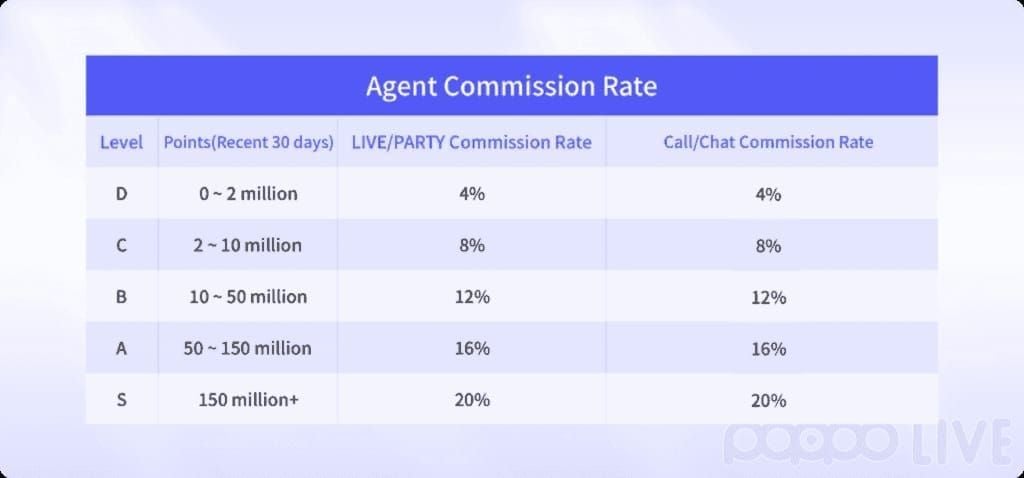
Parent agencies earn tiered commissions based on total monthly host points:
D-tier (0-2M points): 4% live/party, 30% match/chat
C-tier (2-10M points): 8% live/party, 35% match/chat
B-tier (10-50M points): 12% live/party, 40% match/chat
A-tier (50-150M points): 16% live/party, 45% match/chat
S-tier (150M+ points): 20% live/party, 50% match/chat
Official formula: (host earnings × agent rate) + (sub-agent earnings × (agent rate - sub-agent rate)). Parent agencies earn full commission on directly recruited hosts, differential rate on sub-agent-recruited hosts.
Why Commission Rates Range from 45% to 60%
Entry-level sub-agents start at 45-50% splits, reflecting unproven track records. As sub-agents demonstrate consistent performance, recruitment capabilities, and host retention, they gain leverage for 55-60% splits.
Top-tier 60% splits require documented performance proving value exceeds standard support costs: self-sufficiency, high-quality hosts, low churn rates, predictable revenue. Market competition also influences splits—multiple parent agencies competing for productive sub-agents offer higher rates.
Real Commission Split Ranges: The 45%-60% Breakdown
Effective commission rates—actual percentage of host earnings reaching sub-agent pockets—vary dramatically based on split percentage and parent agency tier.
Entry-Level Sub-Agents: 45%-50% Commission Tier
New sub-agents typically receive 45-50% splits. At 50% split under D-tier parent (4% live/party rate), effective sub-agent rate becomes 2%. For every $100 in host points from live streaming (after host's 70% retention), sub-agent earns $2.
Same 50% split under B-tier parent (12% rate) yields 6% effective rate. Under S-tier parent (20% rate), 50% split produces 10% effective rate—five times higher than D-tier despite identical split.
Entry-level qualifications focus on basic competency: platform mechanics understanding, training completion, minimum activity commitment.
Real example: Sub-agent with 50% split under B-tier parent managing hosts generating 2.64M points monthly ($264 total) earns ~$132 monthly.
Mid-Tier Performers: 51%-55% Commission Range
Sub-agents advancing to 51-55% splits demonstrate consistent performance over multiple months: minimal supervision required, above-average host retention, predictable monthly revenue.
Key differentiator: operational independence. Must handle routine host issues without escalating, conduct own recruitment, maintain accurate tracking. Many parent agencies require 1-3M points monthly minimum before considering 51-55% splits.
Documentation critical: performance reports showing month-over-month growth, host retention percentages, average points per host, recruitment conversion rates.
Effective rate improvement from 50% to 55% = 10% income increase on same performance. For sub-agent generating $200 monthly in parent commissions, that's additional $10 monthly—$120 annually.
Elite Sub-Agents: Achieving 56%-60% Commission Rates
The 56-60% tier requires exceptional performance: 10+ active hosts, 5M+ points monthly, 80%+ host retention over six months.
Elite sub-agents function as quasi-independent agencies while leveraging parent's tier status. They conduct own recruitment campaigns, provide comprehensive training, resolve technical issues independently, often develop specialized niches.
Reaching 60% splits requires formal negotiation during renewals, supported by comprehensive documentation: contribution to parent's tier advancement, comparative performance, market rate research.
Financial impact: Using S-tier example with 3.9M points monthly ($390 total), 60% split yields $234 monthly vs $195 at 50%—additional $468 annually.
Hidden Variables Affecting Actual Commission Percentage
Parent agency tier status creates most significant variance—60% split under D-tier (effective 2.4% on live streams) earns less than 45% split under S-tier (effective 9%).
Host composition dramatically affects earnings. Live streams/party rooms generate lower commission percentages (4-20%) vs match/chat (30-50%). Sub-agents whose hosts primarily engage in video/voice chats earn substantially more per point.
Payment timing: Poppo Live processes withdrawals Sundays 23:59 UTC+8 with 1-3 day settlement for cryptocurrency. Minimum withdrawal $10 (100,000 points).
Geographic factors: Philippines market offers 12,000+ coins per dollar vs global 9,460 coins per dollar, affecting viewer spending patterns.
Commission Calculation Methodology
Step-by-Step Formula
Calculation begins with gross viewer spending converted to points. When viewer sends 10,000 coins worth of gifts during live stream, converts to 10,000 points. Host retains 70% (7,000 points), leaving 3,000 points in commission pool.
Parent agency commission applies to this pool based on tier rate. B-tier agency at 12% earns 360 points (3,000 × 0.12) = $0.036.
Sub-agent split then applies. At 50% split, sub-agent receives $0.018 from this transaction. Parent retains remaining $0.018.
For match/chat, hosts keep only 40%, leaving 60% in commission pool. B-tier's 40% match/chat rate applies to larger pool, creating higher commission potential per point.
Real Examples: Calculating Earnings at Different Tiers
Example 1: Sub-agent managing 5 hosts generating 2M points monthly from live streaming. Under D-tier parent (4% rate) with 50% split:
2M points ÷ 10,000 = $200 gross
After 70% host retention: $60 commission pool
Parent's 4% rate: $2.40 × 50% = $1.20 sub-agent monthly
Same performance under B-tier parent (12% rate) with 50% split:
$60 pool × 12% = $7.20 × 50% = $3.60 monthly—3x higher
Example 2: Match/chat-focused operations. 5 hosts generating 2M points monthly through video/voice chats. Under B-tier (40% match/chat rate) with 50% split:
$200 gross × 60% pool = $120 × 40% = $48 × 50% = $24 monthly
Example 3: Mixed content. 8 hosts generating 3.5M points monthly (60% live, 40% match/chat). Under A-tier parent (16% live, 45% match) with 52% split:
Live: 2.1M points = $210 × 30% pool = $63 × 16% = $10.08
Match: 1.4M points = $140 × 60% pool = $84 × 45% = $37.80
Total parent commission: $47.88 × 52% = $24.90 monthly
Complete Negotiation Script Library
Pre-Negotiation Preparation: Data You Must Gather
Compile minimum 3 months performance documentation:
Total points generated monthly
Number active hosts (6+ hours weekly)
Host retention rate (% remaining month-over-month)
Average points per host
Recruitment conversion rates
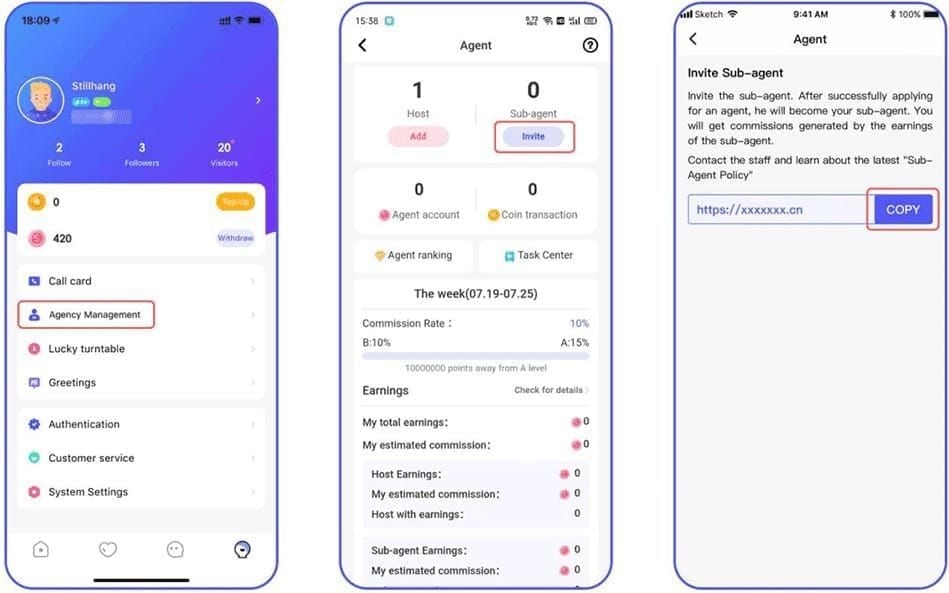
Screenshot My Agency dashboard showing login frequency, streaming hours, cumulative points, recruitment numbers. Export transaction histories demonstrating consistent growth.
Research competitive offers from other parent agencies. Calculate your effective commission rate (split % × parent tier rate) vs direct agent rates at equivalent performance.
Prepare specific requests: target split percentage, minimum acceptable increase, ideal timeline.
Script #1: Initial Contract Negotiation (New Sub-Agents)
Thank you for the opportunity. I've reviewed the standard 45% split and want to discuss starting terms reflecting my existing experience. I currently have relationships with [X] potential hosts ready to join immediately, contributing [estimated points] monthly to your tier advancement. Given this immediate value, I propose 48% starting split with 90-day performance review. I'm committed to reaching [specific threshold] within first quarter. This structure aligns our mutual success.
Without existing network: I understand 45% reflects training investment. I propose tiered structure: 45% months 1-3 while completing training and recruiting first 5 hosts, increasing to 48% once I reach [threshold] monthly, demonstrating operational independence.
Script #2: Performance-Based Rate Increase Request
I'd like to schedule commission review based on my [timeframe] performance. My dashboard shows [specific achievements]: [X]% month-over-month growth, [Y] host retention, [Z] total monthly points. These place me in top [percentile] of your sub-agent network. I'm requesting increase from [X]% to [Y]%, reflecting my contribution to your tier status and operational independence. I've prepared detailed documentation.
Address objections proactively: This represents [X]% increase in my compensation. However, my performance improvements increased my contribution to your total points by [Y]%, and my [Z]% host retention reduces your recruitment costs vs network averages.
Script #3: Contract Renewal Leverage Points
As we approach renewal on [date], I want to discuss next period terms. Over [timeframe], I've consistently delivered [metrics], and I've received inquiries from [number] agencies offering [competitive terms]. I value our relationship and prefer continuing partnership, but need compensation reflecting current market rates and proven performance. I propose [specific terms] for renewal. Can we schedule detailed discussion before [date]?
Strong position: My analysis shows my host network generates [X]% of your total monthly points, contributing significantly to your [tier] status. If I transitioned to direct agency, I'd earn [Y]% effective rates, but lose infrastructure benefits. I propose [Z]% split bridging this gap, allowing mutual benefit from continued collaboration while reflecting my operational scale.
Script #4: Counter-Offer Response Templates
Thank you for the [X]% offer. I appreciate recognition of my performance. However, this represents [Y]% gap from my [Z]% request based on [justification]. I propose middle-ground: [X+increment]% effective immediately, with additional review in [timeframe] if I achieve [targets]. This provides protection while giving me clear path to target rate.
For low offers: I appreciate the offer, but [X]% creates [Y]% gap from market rates for my performance level. Before I can consider this, I need to understand the reasoning. Can you share how this was determined and what performance improvements would justify moving to [target]? Understanding your criteria helps me either improve or recognize if our expectations have diverged.
Common Negotiation Mistakes
Don't negotiate without documentation. Verbal claims lack credibility vs dashboard screenshots and exported metrics.
Don't threaten to leave without genuine alternatives. Only mention competitive offers if you've received concrete proposals and would genuinely consider them.
Don't accept initial offers without counter-proposals. Parent agencies expect negotiation and build room into initial offers.
Don't focus exclusively on split percentages while ignoring tier status. 55% under C-tier yields lower effective rates than 50% under A-tier.
Don't neglect non-commission terms: payment timing, support services, training access, marketing resources.
Essential KPI Dashboard: What to Track and Screenshot
The 12 Critical Metrics
Total Active Hosts: Network size (6+ hours weekly). Track absolute numbers and month-over-month growth.
Cumulative Monthly Points: Foundation for commission calculations. Monitor weekly to project monthly totals.
Average Points Per Host: Network quality. 10 hosts averaging 200K points monthly outperform 20 hosts averaging 80K.
Host Retention Rate: % remaining active month-over-month. Above 80% = strong support. Below 60% = systemic issues.
New Host Recruitment: Monthly additions. Consistent 2-3 hosts monthly offsets attrition, drives growth.
Total Streaming Hours: Engagement levels. Peak hours (7-11 PM weekends) generate 200-300% higher engagement.
Login Frequency: Host commitment. Daily logins correlate with higher viewer retention and gifts.
Content Type Distribution: Live streaming vs party rooms vs match/chat affects commission potential due to differential rates.
Peak Hour Coverage: % of hosts streaming during high-engagement windows. 60%+ maximizes earning potential.
Recruitment Conversion Rate: % of contacted prospects becoming active hosts. Above 20% = effective messaging. Below 10% = wasted effort.
Average Host Tenure: Network stability. 6+ month hosts generate substantially more lifetime value.
Revenue Per Streaming Hour: Efficiency metric. Divides total points by total hours.
Performance Metrics That Unlock Higher Commission Rates
Viewer Engagement Metrics
Video/voice chats yield 1,400-4,200 points per minute when hosts maintain active conversation. PK battles generate ~1,000 points per 30-minute session.
Viewer retention rates (% remaining beyond initial 30 seconds) correlate strongly with gifts. 40%+ retention generates 3-5x more points per viewer than 15-20%.
Peak hour optimization: Coaching hosts to schedule streams during 7-11 PM weekends captures 200-300% higher engagement without content quality improvements.
Revenue Generation
Average gift value per viewer session indicates host effectiveness. $2+ per engaged viewer = strong connection-building. Below $0.50 = needs coaching.
Gift conversion rates: % of viewers sending any gift. Above 15% = strong performance. Below 5% = fundamental issues.
Repeat gifter percentages: 30%+ viewers becoming repeat gifters build stable income streams.
For consistent viewer engagement, ensuring uninterrupted streaming requires reliable coins. Buy Poppo Live coins recharge online through BitTopup's secure platform to support your hosts' interactive features.
Network Growth
Recruitment velocity: Adding 3-5 quality hosts monthly demonstrates strong systems.
Recruitment source diversity: Multiple channels (social media, referrals, communities, forums) build resilient pipelines.
Onboarding completion rates: Above 70% = effective screening and support. Below 40% = poor qualification.
Host development progression: Hosts reaching 100K points monthly within first 60 days = effective training.
Consistency Scores
Week-over-week point variance: Less than 20% variance = predictable performance parent agencies value. 40%+ swings = dependency on individual performers.
Host activity distribution: 80%+ hosts meeting minimum requirements (6+ hours weekly) = strong management.
Response time to host issues: 2-4 hour responses maintain higher satisfaction than 24+ hours.
Training completion rates: 70%+ hosts completing modules outperform 30-40% completion networks.
Strategic Timing: When to Negotiate
Optimal Windows
Ideal window: 2-4 weeks after completing strong performance quarter. Provides recent evidence while allowing projection into next period.
Contract renewal periods: Peak leverage. Parent agencies face disruption costs if productive sub-agents leave. Initiate 60-90 days before expiration.
After helping parent cross tier thresholds: Negotiate within 30 days while contribution remains top-of-mind.
Following platform policy changes increasing operational complexity: Request splits compensating for additional work.
Leveraging Platform Updates
Major updates creating negotiation opportunities when shifting operational responsibilities. New features requiring additional training justify split increases.
Commission structure changes at platform level may create arbitrage. If Poppo increases tier rates, negotiate for proportional split adjustments.
New market expansions: Sub-agents successfully recruiting in newly opened markets demonstrate strategic value justifying premium splits.
Using Competitive Offers
Document specific offers: split percentages, tier status, support services, payment terms before mentioning in negotiations.
Present as market validation, not threats: I've received inquiries offering [terms], suggesting my performance commands [rate] in current market. I prefer continuing partnership given our relationship and your [tier] status, but need compensation reflecting market rates.
Use offers to establish floor rates, not ceiling targets. If another offers 52%, request 54-55%, positioning their offer as minimum acceptable.
Evaluate comprehensively. 55% under C-tier yields lower effective rates than 50% under S-tier. Calculate effective rates before using as leverage.
Contract Renewal Periods
Begin discussions 90 days before expiration. Prevents last-minute pressure while demonstrating serious evaluation.
Prepare comprehensive performance summaries covering entire contract period: growth trends, consistency metrics, contributions to tier advancement.
Request multi-year renewals with graduated increases tied to milestones: Two-year renewal starting at 52%, increasing to 54% at 5M monthly points, 56% at 8M monthly points.
Common Misconceptions
Myth #1: All Sub-Agents Start at 45%
While 45% is common, initial splits vary based on negotiation, existing networks, specialized skills, market conditions. Sub-agents with established relationships or technical expertise often negotiate 48-50% starting splits.
Geographic markets with sub-agent shortages command premium starting rates. Regions where parent agencies compete aggressively see 50-52% starting splits regularly.
Myth #2: Commission Rates Are Non-Negotiable
Virtually all splits are negotiable based on performance, market conditions, competitive alternatives. Productive sub-agents requesting increases with documentation succeed in 60-70% of cases.
Approach professionally with data-driven requests, not emotional appeals. Parent agencies respond to evidence of value creation, competitive rates, clear metrics.
Myth #3: Higher Tiers Require Massive Volumes
Individual sub-agents don't need to generate S-tier volumes (150M+ points) personally. Sub-agent managing 10 hosts averaging 300K points monthly contributes 3M points—meaningful for parent tier advancement without massive individual scale.
Sub-agents benefit from parent's tier status regardless of individual contribution size. Focus on optimizing effective commission rate (split % × parent tier rate) rather than pursuing volume records.
Truth: Setting Realistic Expectations
Realistic first-year earnings: $200-800 monthly for operators managing 5-15 hosts with moderate performance. Exceptional operators with 20+ hosts reach $1,500-3,000 monthly, requiring 6-12 months of network building.
Path to top-tier earnings is gradual:
Months 1-3: Recruit initial hosts, learn platform
Months 4-6: Optimize host performance, retention systems
Months 7-9: Scale recruitment, negotiate first split increases
Months 10-12: Reach sustainable income justifying full-time focus
Commission growth comes from three sources: network expansion (more hosts), performance optimization (higher points per host), split increases (higher percentage). Pursue all three simultaneously.
Advanced Strategies for 60% Commission Tier
Building High-Performance Portfolio
Quality recruitment begins with clear host profiles: minimum 15+ hours weekly availability, technical capabilities (1+ Mbps upload, compatible devices v2.9.6+ on iOS 12.0+/Android 5.0+), outgoing personality, realistic expectations.
Screening includes trial streaming sessions demonstrating basic competency before formal recruitment. Reduces onboarding waste.
Portfolio diversification across content types maximizes earning potential. Networks combining live streamers, party room hosts, match/chat specialists outperform single-format networks by 40-60%.
Strategic host pairing creates mentorship accelerating new host development.
Optimizing Revenue Per Streamer
Peak hour scheduling: Highest-impact optimization. Coaching hosts to concentrate streaming during 7-11 PM weekends captures 200-300% higher engagement without content improvements.
Content format optimization based on individual strengths. Strong conversational skills excel in match/chat (1,400-4,200 points/minute). Performance talents succeed in live streaming and PK battles (1,000 points per 30-minute session).
Viewer relationship development: Personalized greetings for returning viewers, gift acknowledgment systems, consistent scheduling building viewer habits.
Technical optimization: Training on lighting, audio, camera angles, background selection improves viewer retention 20-40%.
Scaling Your Network
Systematic recruitment processes enable consistent growth. Develop standardized outreach scripts, qualification criteria, onboarding checklists, training modules allowing 3-5 hosts monthly without quality degradation.
Recruitment channel diversification: Social media (Instagram, TikTok, Facebook), referral programs, local community outreach (universities, social groups), online platforms (job boards, creator communities).
Automation tools: Scheduling software for coordination, automated reporting for tracking, template libraries for communications, dashboard monitoring for early problem detection.
Delegation beyond 15-20 hosts: Recruit assistant sub-agents handling routine support, allowing you to focus on recruitment, optimization, strategic planning. Structure as revenue shares, not fixed costs.
Maintaining Performance for Tier Retention
Once achieving 60% splits, maintaining justifying performance is critical. Parent agencies monitor continuously and will reduce splits if performance deteriorates.
Establish performance floors: Minimum acceptable metrics for hosts to remain in network. Hosts consistently below 50K points monthly or <6 hours weekly receive 30-day improvement plans before dismissal.
Monthly performance reviews with each host identify issues early. Review point trends, viewer engagement, scheduling consistency, technical issues, provide specific recommendations.
Continuous learning about platform updates, new features, emerging best practices maintains competitive advantage. Participate in parent training, monitor community discussions, experiment with new formats.
Documentation systems tracking all key metrics, host interactions, recruitment activities, performance trends provide evidence for defending split rate or negotiating further increases.
Tools and Resources
Revenue Tracking Spreadsheets
Create comprehensive tracking: host name, recruitment date, weekly streaming hours, weekly points, content type distribution, retention status, performance trends.
Monthly summaries: total network points, estimated commission based on parent tier and split, year-over-year growth, host retention %, recruitment conversion rates.
Cash flow projection templates: accumulated earnings, planned withdrawal dates, estimated settlement times, payment method fees.
Performance comparison templates: benchmark your metrics against parent averages and top performer benchmarks.
Performance Analytics Tools
My Agency dashboard provides real-time access: host login frequency, total streaming hours, cumulative points, recruitment numbers. Screenshot weekly for documentation.
Third-party analytics supplement platform data. Time-series analysis identifies seasonal patterns, day-of-week variations, hour-of-day trends informing scheduling. Cohort analysis tracks host performance by recruitment period.
Host communication platforms centralize interactions, create documentation trails. Use messaging apps with search/archive functions.
BitTopup Services
Reliable coin availability ensures hosts maintain consistent schedules and viewer engagement. BitTopup provides fast, secure Poppo Live coin recharges with competitive pricing.
24/7 availability means hosts can recharge during peak streaming hours without delays. Fast processing ensures coins available immediately for interactive features driving gift generation.
Competitive pricing helps hosts manage operational costs, improving net earnings and satisfaction. Higher host satisfaction = better retention rates and stable commission income.
Wide payment method support: cryptocurrency, regional mobile wallets, bank transfers ensures all hosts can access recharge services.
Community Resources
Experienced sub-agent communities provide knowledge sharing, problem-solving, market intelligence. Participate in forums discussing recruitment strategies, host management, commission negotiation.
Peer networking creates referral opportunities for hosts not fitting your network. Provides competitive intelligence about market rates, parent agency reputations, emerging practices.
Parent agency training resources: webinars, documentation libraries, support channels providing platform updates, feature tutorials, operational guidance.
Industry publications focused on live streaming economics provide broader market context informing strategic planning.
FAQ
What is the average commission rate for Poppo Live sub-agents in 2026?
Sub-agents typically receive 45-50% splits when starting, advancing to 55-60% based on performance. However, effective commission rate depends on parent agency tier. 50% split under B-tier (12% live stream rate) yields 6% effective rate, while same split under S-tier (20% rate) produces 10% effective rate. Focus on effective rates, not split percentages alone.
How do I negotiate a higher commission rate?
Prepare comprehensive performance documentation covering 3+ months: total points, host retention rates, recruitment metrics. Screenshot My Agency dashboard showing consistent performance. Initiate during contract renewals or after strong quarters. Present specific requests (e.g., increase from 50% to 54%) with data justification. Highlight how your performance contributes to parent's tier advancement and reduces operational costs.
What KPIs should sub-agents track?
Monitor: total active hosts (6+ hours weekly), cumulative monthly points, average points per host, host retention rate, new host recruitment, total streaming hours, login frequency, content type distribution, peak hour coverage, recruitment conversion rate, average host tenure, revenue per streaming hour. These provide comprehensive visibility into network health and earning potential.
Can sub-agents realistically earn 60% commission rates?
Yes, but requires exceptional performance: 10+ active hosts, 5M+ points monthly, 80%+ host retention over 6 months, operational independence, strategic value to parent tier advancement. Approximately 10-15% of sub-agents reach this level, typically after 12-18 months consistent performance. 60% represents elite status, not standard progression.
How often does Poppo Live pay sub-agent commissions?
Poppo processes withdrawals weekly Sundays 23:59 UTC+8, with cryptocurrency settlements (Bitcoin, USDT, Ethereum) completing within 1-3 days. Regional payment methods (GCash, PayMaya, OVO, GoPay, MoMo, ZaloPay) and bank transfers require 3-5 business days. Minimum withdrawal $10 (100,000 points) in multiples of $10. Some parent agencies batch sub-agent payments monthly—confirm specific terms in your contract.
What performance metrics affect commission rate increases most?
Host retention rate (80%+ month-over-month) demonstrates effective management, reduces parent recruitment costs. Consistent monthly point generation with <20% week-to-week variance shows reliability parent agencies value for tier planning. Contribution to parent tier advancement—particularly helping cross tier thresholds—creates immediate leverage. Operational independence measured by low escalation rates and self-sufficient problem-solving reduces parent support burden, justifying higher splits.
Ready to maximize your Poppo Live sub-agent earnings? Support your streamers with instant, reliable coin recharges through BitTopup. Fast transactions, competitive rates, and 24/7 service mean your network stays active and your commissions keep growing. Visit BitTopup now to power your sub-agent success.