

Mango Live Diamond scams in 2026 follow predictable patterns. Knowing them before you spend anything is the difference between a safe recharge and losing money to a ghost account. These seven red flags come from community reports and verified platform data: prices 30%+ below market, untraceable payment demands, fabricated screenshots, artificial urgency, credential requests, anonymous sellers, and fake escrow offers. Spot any one of them — walk away.
Why Mango Live Diamonds Are a High-Value Scam Target
Diamonds are worth real money, and the platform grew fast enough that scammers followed the audience.
USD 1 legitimately buys between 3,648 Diamonds (small packages) and 4,422 Diamonds (large packages). During the March 2026 promotion, 165,000 Diamonds cost USD 38.42. High-spending players routinely move 100,000+ Diamonds per week to maintain Guardian Knight status or hit PK coefficient thresholds — that kind of volume makes them a lucrative target pool.
The VIP structure amplifies this. VIP5 requires 125,000 cumulative monthly Diamonds; VIP8 demands 1,000,000. Players chasing those tiers are motivated buyers, and that's exactly the psychological profile scammers exploit. New players get hit by basic price-lure scams. High spenders get targeted by more sophisticated middleman and escrow fraud. The more you spend, the more personalized the scam attempt becomes.
Red Flag #1: Prices That Are Too Good to Be True
More than 30% below the official rate means fraud — not a deal. Community data makes this a mathematical certainty, not a gut feeling.
Legitimate Diamond Rates (March 2026)
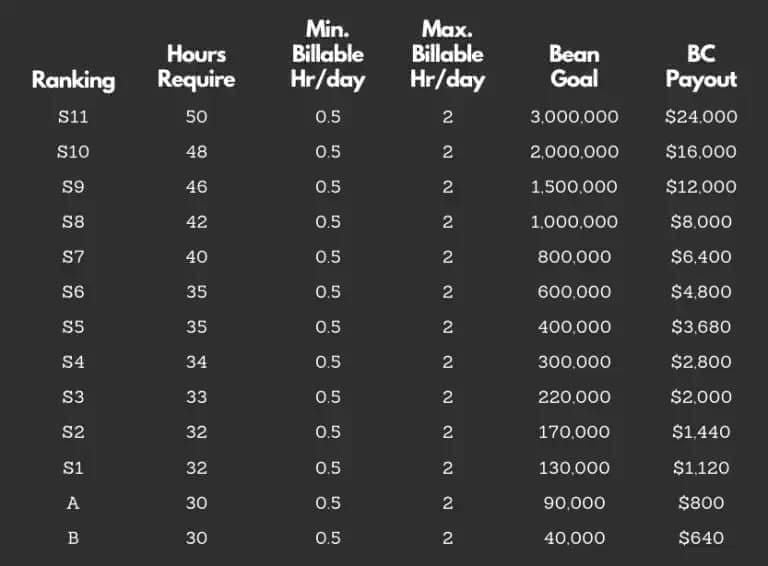
Outside events, small packages run closer to 3,648D/USD. The 80–90% discount claims circulating on Telegram are fraudulent without exception. Community rule: walk away from anything 30%+ below market; run from anything 80%+ below.
A typical scenario: a Telegram account posts 165k Diamonds for USD 15 — limited batch, DM now. That's roughly 11,000D/USD, nearly triple the legitimate rate. It looks like an insider deal. It isn't. The moment you DM, you've entered Stage 1 of the scam playbook.
Red Flag #2: Untraceable or Irreversible Payment Methods
Scammers don't accept credit cards. That's not a coincidence — it's the architecture of the fraud.
Credit cards offer chargebacks. Crypto, gift-card-loaded e-wallets, and peer-to-peer transfers do not. When a seller insists on irreversible payment, they're eliminating your only recovery mechanism before the transaction happens.
Community data confirms that credit card top-ups through legitimate channels achieve 94–97% success rates with delivery in 5–15 seconds. Carrier billing drops to 85–88% with 30–120 second delays. Scammers avoid both because both leave paper trails.
The send first, receive Diamonds after structure is the tell. Every legitimate Mango Live recharge platform delivers Diamonds automatically upon payment confirmation — no human intermediary holds your Diamonds while waiting for your transfer to clear. If you want to buy Mango Live Diamonds safely, the transaction should never require sending money to a person.
Red Flag #3: Fabricated Screenshot Proof
This is the red flag most guides skip — and one of the most effective manipulation tools scammers use.
Basic image editing tools can replicate a Mango Live wallet confirmation screen. Scammers show you a screenshot of successful delivery to a previous buyer, complete with a Diamond balance update and timestamp. None of it is verifiable from your end.
Visual tells that distinguish real from fake:
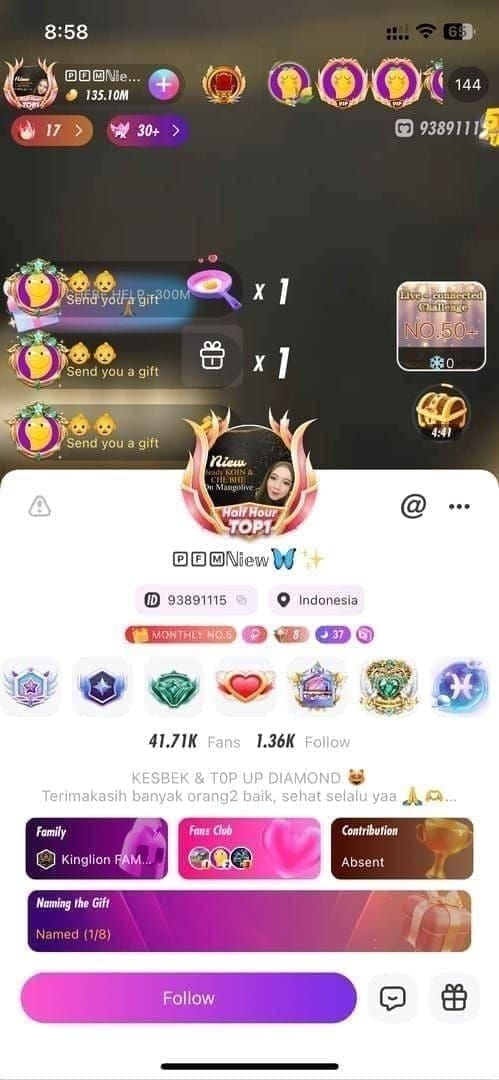
Real confirmations display the recipient's User ID as U0100 followed by exactly 10 digits. Fake screenshots often show truncated IDs, wrong digit counts, or generic usernames.
Real delivery timestamps align with known windows: 85% of legitimate transactions complete within 10 seconds, 12% within 10–40 seconds. New accounts under 3 days old face 24–48 hour security holds on large purchases — a screenshot showing instant delivery of 165,000 Diamonds to a new account should raise immediate questions.
Real wallet screens show Diamond totals matching actual package denominations. Scammers often show round numbers like 50,000 Diamonds delivered that don't correspond to any real package.
You cannot verify a screenshot. You can only verify your own wallet balance after a transaction through a legitimate channel. Any seller who leads with screenshots as their primary trust signal is working around the fact that they have no verifiable track record.
Red Flag #4: High-Pressure Urgency and Artificial Scarcity
Urgency is a scammer's most reliable tool because it works on everyone — including experienced players who know better in calm moments.
Scammers targeting Mango Live players specifically exploit the platform's real time-sensitivity. PK events have deadlines. VIP tier resets happen monthly. Guardian Knight status requires 100,000 Diamonds per week. These are genuine pressures. Scammers mirror that language to make fake urgency feel contextually appropriate.
Common urgency scripts in Mango Live communities:
Last batch at this price — 3 spots left, going fast
Price goes up tonight at midnight
My supplier only gave me 10 packages, 7 already sold
Confirm in the next 10 minutes or I give it to the next person
None of these claims can be verified. A legitimate recharge platform has no batches and no countdown. The counter-move is simple: if an offer disappears the moment you ask for 24 hours to verify the seller, it was never a real offer.
Red Flag #5: Anyone Asking for Your Login Credentials
No legitimate Diamond seller, platform, or service ever needs your Mango Live username and password. Full stop.
Account takeover follows a predictable sequence: the scammer logs in, changes the linked email and phone number, locks you out, then either drains your Diamond balance or uses your VIP status to run secondary scams on your followers. VIP3 and above have access to 85% of hidden rooms — a compromised high-VIP account becomes a tool for further fraud.
Phishing URLs are a parallel threat. These links replicate the Mango Live login page visually and circulate in DMs and community groups. The URL is the tell — legitimate Mango Live authentication happens within the official app or through the official domain. Any link asking you to log in to verify your purchase or confirm your account to receive Diamonds is a phishing attempt.
The app uses TLS 1.3 encryption for all transactions. A phishing page can't replicate that security layer — but it can replicate the visual interface convincingly enough to capture your credentials before you notice.
Red Flag #6: Anonymous Sellers With No Verifiable Track Record
A seller with a 3-day-old account, 12 followers, and screenshots as their only proof of legitimacy is not a seller. They're a setup.
Mango Live community groups on Telegram, Discord, and Facebook are the primary scam recruitment grounds in 2026. New accounts join, post helpful comments to build credibility, then offer exclusive rates via DM. The trust-building phase can last days before the ask comes.
Red Flag #7: Unsolicited Middleman or Escrow Offers
This variant has become significantly more common in Mango Live Telegram communities — and most existing guides don't cover it.
You're negotiating with a seller in a group chat. A third account volunteers to act as escrow to protect both parties. You send money to the escrow. The escrow confirms receipt and tells the seller to deliver. The seller delivers nothing. Both accounts go silent or blame each other.
The triangle — buyer, fake seller, fake escrow — is often operated by the same person or coordinated team. The escrow account exists solely to add apparent legitimacy.
The rule: Any escrow offer from someone you didn't independently verify before the transaction began is fraudulent. Legitimate escrow services are established platforms with public dispute resolution — not a Telegram account that appeared in your group chat 20 minutes ago.
How a Full Mango Live Diamond Scam Unfolds
Understanding the sequence helps you recognize you're mid-scam before money leaves your account.
Stage 1 — Discovery: You encounter the offer in a community space (Telegram, Discord, Facebook, TikTok Live comments). The price is attractive. The account looks semi-legitimate.
Stage 2 — Trust-building: The scammer engages warmly, shares proof screenshots, maybe even delivers a small test amount (3,000 Diamonds at a loss) to establish credibility before the larger ask.
Stage 3 — The transaction: Urgency is introduced. A larger package is offered at an even better rate, but only if you pay now. Payment goes to an irreversible method.
Stage 4 — Disappearance: Diamonds don't arrive. The scammer vanishes, runs delay tactics (server issues, give it 30 minutes), or blames you for a wrong User ID before blocking.
That delay tactic specifically mimics legitimate platform behavior — real Mango Live transactions do occasionally take up to 30 minutes for 3% of purchases. Scammers exploit that known window to extend the con.
If You've Been Scammed: Immediate Steps
Move fast. The first 30 minutes determine how much damage you can limit.
Secure your account. Change your Mango Live password, update your linked email and phone number, enable any available two-factor authentication.
Document everything before it disappears. Screenshot every message, the seller's profile, their account ID, transaction IDs, and payment confirmations. Scam accounts delete themselves quickly.
Contact Mango Live support with your evidence package. Include your User ID (U0100 + 10 digits), the scammer's account details, timestamps, and payment records.
Contact your payment platform. Credit card? Initiate a chargeback immediately — this is why community experience strongly favors credit cards (94–97% success, full buyer protection) over irreversible methods.
Post a scam alert in the community. The same groups where scammers recruit are where warnings spread fastest. A specific post with the scammer's username, account ID, and their exact pitch protects other players.
How to Recharge Mango Live Diamonds Safely
The safest recharge requires only your User ID — nothing else.
The legitimate process: open the app, tap Profile in the bottom-right corner, copy your User ID (U0100 + 10 digits), select a package on a verified platform, enter your ID at checkout, verify the balance in your wallet within 1–10 seconds. No password. No external login. No human intermediary.
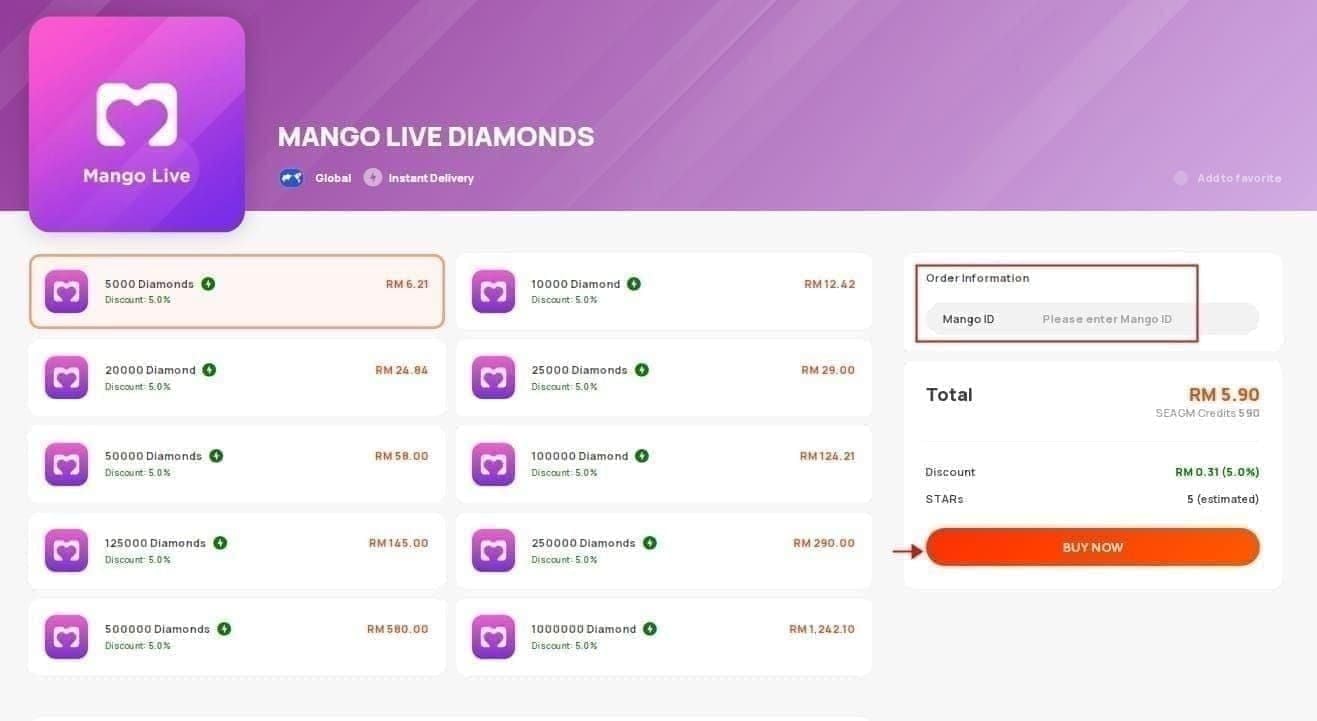
For players looking to recharge Mango Live Diamonds with secure payment, BitTopup processes transactions without requiring your login credentials — your User ID is all that's needed, with delivery following the same 85%-within-10-seconds timeline as official channels.
Pre-Transaction Checklist
Before any Mango Live Diamond purchase, run through these five questions:
Does the price fall within 30% of the official rate?
Is payment processed automatically, or am I sending money to a person?
Am I being asked for anything beyond my User ID?
Can I verify the seller's track record independently — not through screenshots they provided?
Is there urgency pressure to decide right now?
Real pricing doesn't expire in 10 minutes. If you feel rushed, that's the answer.
Timing Your Recharge
Off-peak hours (3–7 AM) achieve 99.2% success rates with delivery under 6 seconds. Peak hours (8–11 PM) see 15–20% higher failure rates. For bulk purchases during events like the March 2026 70% promotion, the community recommends stockpiling 1–3 months of supply — but not more than 3 months, since VIP mechanics and event structures shift enough to make over-stockpiling inefficient. The optimal bulk target is 165,000 Diamonds, which clears Guardian Knight status at the best per-Diamond value and reduces PK penalties by 30–50% at the 165k/week threshold.
Frequently Asked Questions
Can Mango Live Diamonds be transferred between accounts by sellers?
No. Diamonds enter your account only through an official top-up tied to your User ID. Any seller claiming they can transfer Diamonds directly from their account is describing a process that doesn't exist on the platform.
Why are some Mango Live Diamond prices so cheap on certain websites?
Either it's a scam, or it's a verified promotional event. The March 2026 event brought 165,000 Diamonds to USD 38.42 — a genuine discount. Outside verified events, any price dramatically below the 3,648–4,422D/USD baseline is fraudulent or involves stolen payment methods, which creates legal risk for the buyer. There's no sustainable legitimate business model supporting 80–90% discounts.
What should I do if someone asks for my Mango Live login to send Diamonds?
Refuse immediately and report the account. No legitimate service requires your login credentials to top up your balance. Your User ID is the only identifier needed. If you've already shared credentials, change your password and linked contact information immediately, then contact Mango Live support.
How do scammers fake Mango Live Diamond transaction proof?
Basic image editing replicates the wallet confirmation screen. Key tells: incorrect User ID format (not U0100 + exactly 10 digits), delivery timestamps that contradict platform behavior, and Diamond totals that don't match any real package denomination. Only trust your own wallet balance after a transaction through a verified channel.
Are Mango Live Diamond giveaways on social media ever legitimate?
Occasionally — but official giveaways are announced through the official app and official social channels, not through DMs from individual accounts. Any unsolicited DM claiming you've won Diamonds, or asking you to claim a giveaway via link or login, is a phishing attempt.
How do I report a scam account inside the Mango Live app?
Navigate to the scammer's profile, tap the three-dot menu, and select the report option. Include their User ID, the nature of the scam, and any transaction references. For financial losses, supplement the in-app report with a direct contact to Mango Live customer support — bring your full evidence package including screenshots and payment records.
Every Mango Live Diamond scam in 2026 relies on at least one of these seven red flags. Prices below market, untraceable payments, unverifiable screenshots, artificial urgency, credential requests, anonymous sellers, fake escrow — these aren't independent tactics, they're a toolkit. Scammers mix and match them based on how you respond. Know the playbook, and you can exit at any stage before any money moves.