

Matador's Muleta Mastery defines Season 41 contain-assist gameplay through precise mechanical execution. This guide dissects seven critical micro-mechanics transforming Hernando Romero from Difficulty Level 2 survivor into competitive kiting powerhouse. Master the 16-meter dual-dash system, 50% Hunter slow, and Gaonera Pass deployment while understanding hard counters like Dream Witch's 6.08 m/s speed advantage. Optimize 70-second energy cycles and 0.6-second cleave timing for measurable kite improvements.
What is Matador Muleta Tech? Understanding the Foundation
Matador Muleta tech encompasses advanced mechanical execution of Hernando Romero's signature ability system. Released February 5, 2026 at 08:00 UTC+8, this contain-assist survivor operates through three interconnected abilities: Muleta Mastery, Gaonera Pass, and Faena. The technical foundation centers on managing two energy charges with 70-second durations and 11-second cooldowns.
Muleta Mastery executes a dual-dash sequence covering 6 meters initially, followed by 10-meter extension for 16 total meters displacement. During the 0.6-second cleave animation, Matador creates a 2.5-meter radius zone applying devastating 50% movement speed reduction to Hunters for 2.5 seconds. This transforms standard 4.6 m/s Hunter speed into 2.3 m/s, creating critical distance gaps. Additionally, Muleta Mastery grants permanent 10% Interaction Speed increase, reducing Rocket Chair rescue time from 0.86 to 0.77 seconds.
For players seeking to maximize Matador potential, Identity V echoes top up for Matador essence provides fast access to Season 41 content. BitTopup offers competitive pricing and secure transactions.
Muleta Ability Breakdown: Mechanics and Cooldowns
Energy charge system operates with Initial/Max counts of 2/2, requiring strategic resource management. Each 70-second charge duration demands precise timing awareness, as premature usage leaves Matador vulnerable during critical chase moments. The 11-second cooldown between activations creates rhythm patterns experienced players exploit.
Gaonera Pass introduces Courage mechanic, requiring 100 Courage accumulation for activation. Players generate 40 Courage per Muleta Mastery usage, with additional passive generation at 2 per second within 16 meters of Hunter and 1 per second beyond 16 meters inside Terror Radius. This grants 2 charges per match, deploying stationary Muleta for 8 seconds within 25-meter range that decreases Hunter Interaction Speed by 10%.
Faena provides passive area control within 6 meters, reducing Hunter Movement Speed by 10% while increasing Survivor Vaulting Speed by 10%. Combined with Matador's base 3.8 m/s running speed, this creates layered defensive zones. Under Faena's influence, standard Hunter speed drops from 4.6 m/s to 4.14 m/s.
Why Muleta Tech Separates Good from Great Players
Mechanical precision determines Matador's effectiveness across skill tiers. The 0.6-second cleave window demands frame-perfect timing against experienced Hunters who anticipate activation patterns. Great players chain the 16-meter dual-dash with environmental objects, extending single kites from 30-40 seconds to 60-80 seconds through optimal resource cycling.
Courage generation system rewards aggressive positioning. Players maintaining 12-15 meter distances from Hunters maximize 2 per second generation rate while preserving safety margins. This accelerates Gaonera Pass availability, transforming it from late-game desperation tool into mid-game strategic asset.
Interaction Speed optimization separates elite Matador players. The 10% boost reduces pallet dropping time from 0.66 to approximately 0.59 seconds, creating micro-advantages accumulating across match duration. Combined with 0.77-second rescue time, Matador becomes premier rescue specialist.
Season 41 Meta Context
Season 41 positions Matador as specialized contain-assist survivor excelling in coordinated team compositions. The 81-second Cipher Machine decoding time remains unchanged, emphasizing Matador's role as dedicated kiter rather than decoder. Difficulty Level 2 classification reflects mechanical execution ceiling required.
Current meta features mobility-focused Hunters challenging traditional kiting patterns. Trait Build 129 prioritizes mobility enhancements, Build 39 emphasizes kiting extensions, Build 36 optimizes rescue capabilities. Players must adapt builds based on Hunter selections and team compositions.
Transition kiting using 12-15 meter routes between tiles defines optimal Matador gameplay. Pallet drops executed at 8-meter distances create predictable Hunter responses skilled players exploit through Muleta timing. Season 41 Essence 1 guaranteed S-Tier at 250 pulls requires 79,500 Echoes.
Micro-Mechanic #1: Frame-Perfect Angle Manipulation
Angle manipulation constitutes foundational Muleta tech skill determining distance gained per activation. The dual-dash system's 6-meter and 10-meter components respond differently to directional input timing, creating optimization opportunities through precise camera control.
The 45-90 Degree Sweet Spot

Optimal Muleta angles range between 45-90 degrees relative to Hunter's approach vector. Perpendicular 90-degree activations maximize lateral displacement, forcing Hunters to commit to wider turning arcs consuming additional chase time. The 6-meter initial dash establishes positioning, while 10-meter extension capitalizes on Hunter movement prediction errors.
Acute angles below 45 degrees sacrifice distance efficiency for directional control. These applications suit narrow corridor scenarios or pallet-dense tiles where lateral space limitations prevent perpendicular dashes. The 16-meter total displacement compresses to approximately 12-13 meters effective distance at acute angles.
Obtuse angles exceeding 90 degrees create backward momentum occasionally benefiting from environmental geometry. Advanced players utilize 120-135 degree activations near walls or obstacles, allowing 10-meter extension to carry them around corners breaking line-of-sight.
Reading Hunter Movement for Optimal Angles
Hunter movement patterns telegraph attack timing and directional commits. Experienced Hunters feint approach angles to bait premature Muleta activations, creating cooldown windows for guaranteed hits. Successful angle selection requires reading subtle animation cues: weapon raise timing, movement speed fluctuations, camera orientation shifts.
The 2.5-second duration of 50% Hunter slow provides critical feedback for angle effectiveness. If Hunters recover positioning within 1.5 seconds post-activation, angle selection was suboptimal. Ideal executions maintain or increase distance gaps throughout slow duration.
Camera positioning during charge phases determines reaction speed. Players maintaining 180-degree camera angles relative to movement direction identify Hunter commits 0.3-0.5 seconds faster than forward-facing cameras. This timing advantage translates to superior angle selection.
Common Angle Mistakes
Parallel angle activations represent most frequent execution error. Dashing in same direction as Hunter movement minimizes relative distance gained, often resulting in net losses when accounting for 11-second cooldown. The 16-meter displacement becomes effectively 8-10 meters when Hunter movement vectors align.
Predictable angle patterns enable Hunter adaptation. Players consistently favoring 90-degree right angles become readable, allowing Hunters to pre-position for post-dash interception. Mixing 45-degree, 75-degree, and 90-degree activations creates unpredictability extending chase duration by 10-15 seconds.
Environmental collision interruptions waste energy charges. The dual-dash system doesn't account for obstacle collision, causing 10-meter extension to terminate prematurely against walls or map boundaries. Players must maintain spatial awareness, reserving Muleta activations for open tile areas.
Micro-Mechanic #2: Cape Swing Distance Optimization
Distance optimization through charge timing manipulation separates competent players from masters. While ability description specifies fixed 6-meter and 10-meter distances, terrain interaction and momentum conservation create variable outcomes ranging from 14 to 18 meters effective displacement.
Charge Timing vs Distance Gained
Muleta Mastery activation sequence operates on fixed distance parameters regardless of charge duration. Unlike abilities with variable charge mechanics, Matador's dual-dash executes identically whether activated immediately or held for extended periods. This eliminates charge timing as distance variable.
The 70-second energy charge duration creates strategic timing windows. Activating charges with 60+ seconds remaining provides psychological pressure, signaling resource availability influencing Hunter decision-making. Conversely, activations below 20 seconds remaining risk entering cooldown phases during critical chase moments.
Cooldown management across 11-second window determines sustained kiting capability. Players chaining Muleta activations at maximum cooldown intervals maintain consistent pressure, while those hoarding charges create vulnerability windows. Optimal usage patterns activate first charge within 15-20 seconds of chase initiation.
Terrain Interaction Effects
Elevation changes amplify or reduce effective displacement. Downhill Muleta activations gain 1-2 additional meters through gravity-assisted momentum, while uphill activations lose similar distances to incline resistance. Maps featuring significant elevation variance like Lakeside Village or Moonlit River Park demand terrain-aware activation timing.
Obstacle density affects post-dash positioning quality. Open tiles allow full 16-meter displacement with optimal angle selection, while cluttered areas force suboptimal angles reducing effective distance to 12-14 meters.
Surface type variations create minor friction differences. Smooth surfaces like indoor flooring maintain momentum better than rough outdoor terrain, though differences measure in centimeters rather than meters.
Micro-Mechanic #3: Hitbox Exploitation During Animation
Hitbox manipulation during 0.6-second cleave animation creates brief windows of reduced vulnerability. Understanding Matador's hitbox behavior during Muleta activation separates players who consistently dodge attacks from those wasting charges absorbing hits.
Understanding Matador's Reduced Hitbox Window
The 0.6-second cleave animation features standard hitbox dimensions without invincibility frames or hitbox reduction. Hunters can interrupt animation with properly timed attacks, wasting Matador's charge while still landing hits.
The 2.5-meter cleave radius creates zone where Hunter positioning determines hit probability. Hunters within this radius during activation experience 50% movement slow, but this debuff doesn't prevent attack execution. Players must position cleave zone to maximize Hunter slow application while maintaining sufficient distance.
Movement during animation follows standard survivor physics. Matador maintains directional control throughout dual-dash sequence, allowing micro-adjustments optimizing final positioning. The 6-meter initial dash completes in approximately 0.3 seconds, with 10-meter extension consuming remaining animation time.
Invincibility Frame Myths vs Reality
No invincibility frames exist during Muleta Mastery activation. Hunters with fast attack animations like Geisha or Sculptor can interrupt Muleta mid-activation, landing hits negating distance advantage while triggering 11-second cooldown.
The 50% Hunter slow creates illusion of invincibility by reducing attack follow-through speed. Hunters affected by 2.5-second slow struggle to position for secondary attacks, giving Matador time to establish distance. This defensive benefit stems from movement speed reduction rather than hitbox invulnerability.
Proper hitbox exploitation focuses on distance maintenance rather than animation abuse. Players activating Muleta at 3-4 meter distances from Hunters create genuine safety through displacement rather than relying on non-existent invincibility frames.
Positioning Against Different Hunter Attack Patterns
Fast-attack Hunters like Geisha require 5+ meter activation distances to prevent mid-animation interruption. Her 0.4-second attack animation completes faster than Matador's 0.6-second cleave window, creating interrupt opportunities if activation occurs within attack range.
Ranged Hunters demand predictive positioning accounting for projectile travel time. Sculptor's statues and Violinist's music notes track Matador's position during dual-dash, requiring angle selection creating line-of-sight breaks or maximum lateral displacement.
Area-control Hunters like Breaking Wheel exploit Muleta's predictable displacement vectors. His 8.03 m/s dash speed allows position pre-emption, intercepting Matador at predicted landing locations. Against such counters, players must incorporate feint patterns and unpredictable angle variations.
Micro-Mechanic #4: Movement Speed Retention Techniques
Momentum conservation after Muleta activation extends effective displacement beyond base 16 meters. Advanced players maintain movement speed through precise directional input timing and sprint integration, gaining 2-3 additional meters per activation.
Momentum Conservation After Cape Swing
Dual-dash sequence terminates with Matador's standard 3.8 m/s running speed. No inherent momentum bonus carries beyond animation completion, requiring players to manually maintain speed through continuous movement inputs. Directional input interruptions or hesitation immediately after activation waste positional advantage.
Sprint ability integration amplifies distance gains. Activating sprint immediately upon Muleta completion chains 16-meter displacement with sprint's enhanced movement speed, creating combined displacement exceeding 20 meters over 3-4 seconds.
Environmental momentum sources like pallet vaults or window transitions compound displacement effects. Players terminating Muleta dashes adjacent to vaultable objects chain 16-meter displacement with vault distance, creating 18-20 meter total separation.
Directional Input Timing for Speed Maintenance
Continuous directional inputs throughout and after Muleta activation prevent speed decay. Game engine interprets input gaps as movement cessation commands, briefly reducing Matador's speed before re-accelerating to 3.8 m/s. Maintaining constant directional pressure eliminates these micro-slowdowns.
Camera-relative directional inputs optimize pathing efficiency. Players aligning camera angles with intended movement directions before activation execute smoother post-dash transitions, maintaining maximum speed through optimized pathing.
Input buffering during 0.6-second animation prepares optimal post-dash movement. Experienced players queue directional inputs during cleave animation, ensuring immediate maximum-speed movement upon completion.
Combining Sprint with Muleta
Sprint activation timing determines combined effectiveness. Immediate post-Muleta sprint activation creates 20+ meter displacement over 4 seconds, overwhelming most Hunter recovery capabilities. However, this aggressive usage depletes sprint resources needed for subsequent kite phases.
The 50% Hunter slow duration of 2.5 seconds provides sprint timing reference. Activating sprint during slow window maximizes relative distance gained, as Hunters can't effectively close gaps while movement-impaired.
Resource coordination between Muleta charges and sprint availability defines high-level gameplay. Players synchronizing both resources for critical moments—cipher completion pressure, rescue attempts, or final kite extensions—demonstrate superior game sense.
Micro-Mechanic #5: Camera Control for Muleta Prediction
Camera positioning determines reaction speed and angle selection quality during chase sequences. Matador players must balance forward awareness for pathing optimization with backward awareness for Hunter tracking.
Camera Positioning During Chase Phase
Optimal camera angles maintain 135-180 degree rotation relative to movement direction during active chases. This positioning provides maximum Hunter visibility while preserving sufficient forward awareness for obstacle navigation. Players maintaining forward-facing cameras sacrifice 0.4-0.6 seconds reaction time to Hunter commits.
Dynamic camera adjustment during kite phases creates information advantages. Experienced players oscillate between backward Hunter tracking and forward pathing assessment at 1-2 second intervals, building comprehensive situational awareness.
The 2.5-meter cleave radius requires precise Hunter distance estimation. Camera positioning directly affects distance judgment accuracy—players using backward-facing cameras estimate Hunter proximity 30-40% more accurately than those relying on Terror Radius audio cues alone.
Tracking Hunter Position While Charging Cape
Muleta Mastery features no charge duration requirement, eliminating need for sustained tracking during charge phases. Players can activate ability instantly upon input, shifting tracking emphasis to pre-activation positioning assessment.
Pre-activation Hunter position assessment determines angle selection quality. Players verifying Hunter location within 0.3 seconds of activation execute superior angle choices compared to those activating based on outdated positional information.
Audio cue integration supplements visual tracking. Hunter ability sounds, footstep audio, and Terror Radius intensity provide positioning information during moments when camera angles prevent direct visual confirmation.
Quick-Turn Camera Techniques
Emergency activations demand rapid 180-degree camera rotations for backward angle selection. Players practicing quick-turn techniques execute these rotations in 0.2-0.3 seconds, enabling reactive Muleta usage against unexpected Hunter commits.
The 6-meter initial dash provides brief repositioning time before 10-meter extension. Players can execute camera adjustments during this 0.3-second window, correcting suboptimal initial angles before extension component commits to final direction.
Muscle memory development for camera-Muleta coordination requires dedicated practice. Custom mode training against AI Hunters builds neural pathways necessary for instinctive camera-angle-activation sequences. Competitive players invest 10-15 hours in isolated camera control practice.
Micro-Mechanic #6: Chaining Muleta with Environmental Objects
Environmental object integration transforms Muleta from simple displacement tool into comprehensive kiting system. Pallet drops, window vaults, and map tile transitions create multiplicative distance gains when properly chained.
Pallet-to-Muleta Transition Timing

Optimal pallet drop timing occurs at 8-meter Hunter distances during standard kiting. This distance forces Hunters to commit to pallet destruction or wide routing, creating predictable responses Matador players exploit. Dropping pallets at closer distances risks hits during 0.66-second animation.
Muleta activation immediately post-pallet-drop chains displacement effects. Pallet forces Hunter decision point—destroy or route—while Muleta capitalizes on committed action. If Hunters destroy pallet, 16-meter dash creates 20+ meter total separation. If Hunters route, Muleta extends separation to 25+ meters.
The 10% Interaction Speed bonus reduces pallet drop time to approximately 0.59 seconds, creating tighter timing windows for chained execution. This speed advantage allows Matador to drop pallets at closer distances than other survivors.
Window Vault Integration
Window vaults provide directional control points for Muleta angle optimization. Players positioning vaults between themselves and Hunters create forced approach vectors enabling predictable angle selection. The 10% Vaulting Speed increase from Faena reduces vault time by approximately 0.1 seconds.
Pre-vault Muleta activation wastes displacement potential by committing to vault-side positioning. Optimal sequencing vaults first, then activates Muleta post-vault to extend distance in optimal direction based on Hunter routing decisions.
Map-specific vault-Muleta combinations create extended kite sequences. Tiles featuring multiple window vaults within 15-meter ranges enable vault-Muleta-vault chains generating 30+ meter separations over 5-6 seconds.
Map-Specific Tile Combinations
Transition kiting using 12-15 meter routes between tiles defines optimal Matador gameplay patterns. These distances align with Muleta's 16-meter displacement, enabling tile-to-tile transitions maintaining continuous kiting pressure. Maps with clustered tile layouts like Eversleeping Town or Moonlit River Park favor this playstyle.
Cipher machine positioning influences tile transition viability. Matadors kiting near cipher clusters enable teammates to capitalize on extended chase durations, converting kite time into decoding progress. The 81-second cipher decode time means 60+ second kites allow 70-75% cipher completion.
High-wall tiles amplify Muleta effectiveness through line-of-sight breaks. The 10-meter extension component carries Matador around corners breaking Hunter vision, creating reset opportunities where Hunters must reacquire visual contact.
Micro-Mechanic #7: Muleta Feint Patterns Against Experienced Hunters
Predictability represents Matador's greatest vulnerability against skilled Hunters. Players developing varied feint patterns and unpredictable activation timing prevent Hunter adaptation, extending kite durations by 20-30 seconds.
Creating False Charge Signals
Movement hesitations and directional changes create false activation signals baiting Hunter defensive responses. Experienced Hunters anticipate Muleta timing based on distance thresholds and movement patterns, pre-positioning to intercept predicted landing locations.
Absence of charge duration requirements simplifies feint execution. Players can simulate activation preparation through movement stutters without committing to actual charge time, creating ambiguous signals Hunters must respect.
Courage generation visibility creates additional feint opportunities. Hunters tracking Matador's Courage accumulation anticipate Gaonera Pass availability, often adjusting positioning preemptively. Players varying Courage generation patterns through intentional distance manipulation create unpredictable Gaonera Pass timing.
Mixing Activation Patterns for Unpredictability
Matador's instant activation system eliminates traditional charge-timing mixups, but activation frequency variation creates similar unpredictability. Players alternating between aggressive early activations and conservative delayed activations prevent Hunters from establishing reliable timing predictions.
Resource conservation signals influence Hunter aggression levels. Matadors activating both charges early in chases signal resource depletion, encouraging aggressive Hunter commits. Players preserving one charge create persistent threat forcing conservative Hunter positioning.
The 11-second cooldown creates rhythm patterns experienced Hunters exploit. Breaking these rhythms through irregular activation timing—sometimes activating immediately upon cooldown completion, other times delaying 3-5 seconds—prevents Hunters from synchronizing ability usage.
Reading Hunter Adaptation and Counter-Adapting
Successful Hunters adapt to Matador patterns within 30-40 seconds of chase initiation. Players must identify these adaptations through Hunter positioning changes, ability usage timing shifts, and approach angle modifications. Counter-adaptation within 10-15 seconds maintains kiting effectiveness.
Gaonera Pass deployment forces Hunter adaptation through area denial. The 8-second duration with 10% Interaction Speed reduction creates zones Hunters must respect or suffer significant time losses. Strategic placement near cipher machines or rescue targets forces Hunter routing decisions.
The 100 Courage requirement for Gaonera Pass creates telegraphed availability windows. Skilled Hunters track Courage accumulation and adjust positioning when activation becomes possible. Players varying Gaonera Pass usage patterns prevent effective Hunter counterplay.
Hard Counters: 5 Hunters That Shut Down Muleta Tech
Specific Hunter kits neutralize Matador's mechanical advantages through superior mobility, area control, or ability interactions. Understanding these matchups enables informed character selection and adaptation strategies.
Why These Hunters Neutralize Matador
Dream Witch: 6.08 m/s follower speed exceeds Matador's kiting capabilities. Multi-body pressure negates single-target kiting advantages, as followers maintain chase pressure while main body applies map pressure. The 16-meter Muleta displacement provides temporary separation, but Dream Witch's sustained speed advantage enables recovery within 4-5 seconds.
Breaking Wheel: 8.03 m/s dash speed creates interception opportunities bypassing Muleta's defensive benefits. His mobility allows position pre-emption, arriving at predicted Muleta landing locations before Matador completes dual-dash. The 50% Hunter slow proves ineffective against ability-based movement.
Sculptor: Statue network creates unavoidable damage scenarios wasting Muleta charges. Area control forces Matador into predictable pathing enabling statue placement at key locations. The 16-meter displacement often carries Matador directly into pre-positioned statues.
Geisha: Dash and teleport mechanics counter Muleta's displacement advantages. Her 0.4-second attack animation enables mid-Muleta interruption when properly timed, while dash ability matches or exceeds 16-meter displacement. The 50% slow proves ineffective during ability-enhanced movement phases.
For players looking to expand their roster and counter-pick options, buy Identity V echoes recharge online through BitTopup's secure platform. Fast delivery and competitive rates ensure you're always prepared.
Adaptation Strategies When Facing Counter Picks
Conservative Muleta usage against hard counters preserves resources for critical moments. Rather than using charges for distance creation, players should reserve them for rescue scenarios or final cipher pressure situations where value maximizes despite matchup disadvantages.
Team coordination becomes essential against counters neutralizing individual kiting. Matadors facing Dream Witch or Breaking Wheel should prioritize quick rescues and decoder support over extended kiting attempts. The 0.77-second rescue time enables fast chair saves minimizing team resource expenditure.
Map selection influences counter matchup severity. Open maps with sparse tile density amplify mobility-based counter advantages, while dense maps with numerous vaults and pallets provide environmental tools partially compensating for ability disadvantages.
Alternative Kiting Approaches
Environmental kiting replaces ability-dependent strategies against hard counters. Maximizing pallet and vault efficiency through tight-kite techniques extends chase duration without relying on Muleta displacement. The 10% Vaulting Speed from Faena provides consistent value regardless of Hunter matchup.
Gaonera Pass deployment shifts from offensive kiting tool to defensive area denial. Placing stationary Muletas at cipher machines or rescue locations forces Hunters to respect zones even when direct kiting proves ineffective. The 10% Interaction Speed reduction compounds with 8-second duration to create 0.8-second delays per interaction.
Team-based kiting strategies distribute chase burden across multiple survivors. Matadors initiating kites then transitioning to teammates after 20-30 seconds prevent counter Hunters from capitalizing on matchup advantages throughout entire chases.
Optimal Persona Build for Muleta-Focused Gameplay
Persona talent selection amplifies Matador's mechanical strengths while compensating for inherent weaknesses. Three primary builds serve distinct playstyles: Build 129 for mobility, Build 39 for kiting extension, Build 36 for rescue optimization.
Essential Persona Talents for Kite Extension
Build 39 prioritizes kiting-focused talents extending chase duration through enhanced survivability and resource efficiency. Core talents include:
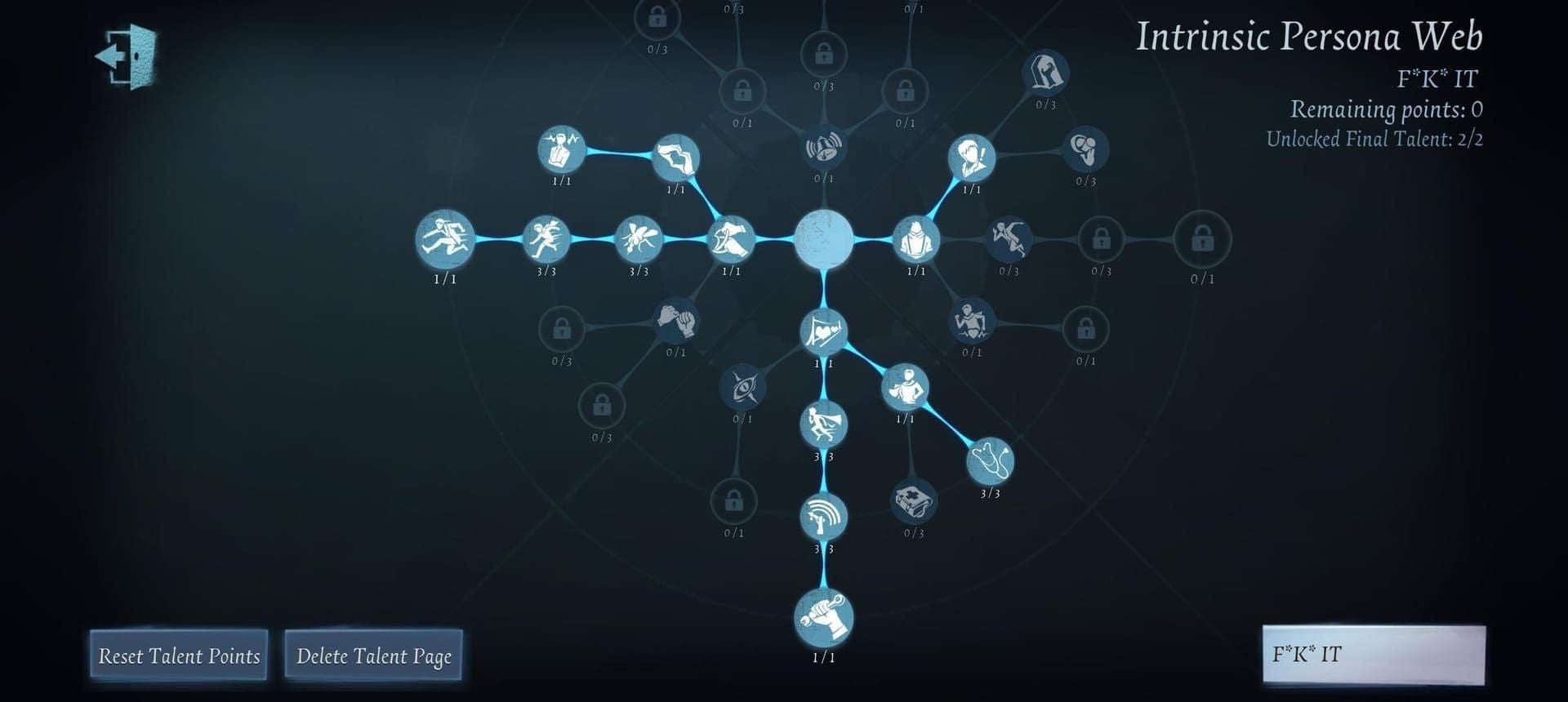
Borrowed Time for post-rescue protection
Tide Turner for rescue invincibility
Knee Jerk Reflex for pallet stun duration extension
These selections transform Matador into dedicated kiter capable of 80+ second chases against non-counter Hunters.
Broken Windows talent synergizes with Matador's 10% Vaulting Speed from Faena, creating compound vault speed increases reducing vault time to 0.9-1.0 seconds. This speed advantage enables tighter vault timing maximizing distance gained per vault.
Exit Path provides movement speed increases after vault completion, compounding with Muleta's displacement for superior distance creation. Talent activates upon vault completion, creating 2-3 second windows of enhanced movement chaining naturally with post-Muleta positioning.
Secondary Talents That Complement Muleta Tech
Build 129 emphasizes mobility talents enhancing Matador's 3.8 m/s base running speed and transition kiting capabilities. Quick and Nimble provides vault speed increases, while Resilience reduces recovery time from attacks. These selections optimize Matador's ability to execute 12-15 meter tile transitions.
Distress provides team coordination benefits through enhanced healing speed when injured. While not directly enhancing Muleta tech, this talent enables faster recovery between kites, maintaining Matador's availability for subsequent chase phases.
Cold provides movement speed increases when healthy, synergizing with Matador's contain-assist role. Talent encourages aggressive positioning maximizing Courage generation through close Hunter proximity, accelerating Gaonera Pass availability.
Season 41 Build Adjustments
Build 36 optimizes rescue capabilities through talents enhancing Matador's 0.77-second rescue time and post-rescue survival. Tide Turner provides rescue invincibility, while Borrowed Time grants post-rescue protection to rescued survivors. These selections transform Matador into premier rescue specialist.
Current Season 41 meta favors mobility-focused Hunters challenging traditional kiting patterns, making Build 129's mobility emphasis increasingly valuable. Players should prioritize movement speed and vault efficiency talents over pure survivability selections.
Persona point allocation flexibility allows mid-match adaptation through talent resets. Players identifying unfavorable Hunter matchups during loading screens can adjust builds to emphasize rescue capabilities over kiting extensions, maximizing team value despite individual disadvantage.
Training Regimen: How to Master Muleta Mechanics
Systematic practice routines accelerate Muleta tech mastery through isolated skill development and progressive difficulty scaling. Custom mode training against AI Hunters provides controlled environments for mechanical refinement.
Custom Mode Practice Drills
Angle manipulation drills isolate directional input timing from chase pressure. Practice 45-degree, 75-degree, and 90-degree activations against stationary targets, measuring distance gained per angle through landmark references. This controlled practice builds muscle memory for angle selection.
Distance optimization drills focus on terrain interaction effects and momentum conservation. Execute Muleta activations on various surface types, elevation changes, and obstacle densities, documenting effective displacement variations. This empirical data informs real-time decision-making during matches.
Camera control drills develop quick-turn capabilities and backward tracking proficiency. Practice 180-degree camera rotations while maintaining continuous movement, measuring rotation speed and movement disruption. Competitive standards require 0.2-0.3 second rotation times with minimal movement deviation.
Progression Milestones
Beginner: Achieve 90%+ successful activation rates in custom mode before attempting ranked application. This baseline competency ensures resource efficiency and prevents charge waste through mechanical failures.
Intermediate: Consistently execute 90-degree activations maximizing distance while chaining Muleta with pallets or vaults in 70%+ of opportunities. This integration transforms Muleta from isolated ability into comprehensive kiting system.
Advanced: Demonstrate varied activation timing preventing Hunter prediction while adapting to Hunter pattern changes within 15 seconds of identification. This psychological gameplay layer separates elite Matador players from mechanically competent performers.
Common Execution Errors
Premature activation represents most frequent execution error, wasting charges before Hunters commit to attack range. Practice activation delay discipline, waiting until Hunters reach 3-4 meter distances before executing Muleta.
Predictable angle patterns enable Hunter adaptation and interception. Consciously vary angle selection across consecutive activations, avoiding repetitive 90-degree right or left patterns. Recording and reviewing gameplay footage reveals unconscious pattern tendencies.
Poor camera positioning creates reaction delays and suboptimal angle selection. Maintain 135-180 degree camera rotation during chase phases, practicing this positioning until it becomes instinctive.
Advanced Tips from High-Tier Matador Mains
Competitive Matador gameplay incorporates situational awareness and team coordination transcending mechanical execution. These advanced concepts separate tournament-level players from ranked ladder performers.
Situational Muleta Applications
Rescue scenarios: Preserve at least one charge for post-rescue distance creation, as 0.77-second rescue time creates vulnerability windows requiring immediate displacement. Pre-rescue Muleta usage often results in charge depletion during critical survival moments.
Final cipher pressure: Activate both charges during final kites, prioritizing duration over resource conservation. Match-ending context eliminates future resource needs, making immediate time waste the sole optimization criterion.
Early-game kites: Conservative charge usage establishes psychological pressure without resource depletion. Activating one charge during first chase signals capability while preserving resources for subsequent phases.
Team Coordination: When to Kite vs Transition
Cipher progress determines optimal kite duration. Maintain kites until nearby ciphers reach 90%+ completion, then transition to fresh tile areas enabling teammates to complete ciphers safely. The 81-second decode time means 60-second kites allow 74% completion.
Hunter ability cooldowns influence transition timing. Track Hunter ability usage and transition during cooldown windows preventing ability-enhanced chase continuation. This strategic timing forces Hunters to choose between continuing chase with reduced effectiveness or rotating to pressure other survivors.
Team composition affects Matador's role priority. In decoder-heavy compositions, prioritize extended kiting over rescue attempts. In rescue-focused compositions, 0.77-second rescue time justifies aggressive rescue attempts other survivors can't safely execute.
Mental Game: Staying Calm Under Pressure
Pressure management separates consistent performers from players who excel in practice but falter in competition. Develop pre-match routines establishing calm mental states, as mechanical execution quality directly correlates with stress levels.
Mistake recovery protocols prevent single errors from cascading into match losses. Players wasting Muleta charges through poor timing should immediately shift to environmental kiting rather than dwelling on error.
Long-term improvement focus reduces match-by-match performance pressure. View individual matches as data points in extended learning curves rather than isolated success/failure events. This perspective enables experimentation and risk-taking accelerating skill development.
Enhance Your Identity V Experience with BitTopup
Maximizing Matador's potential requires access to Season 41 content, cosmetics, and essence pulls. BitTopup provides fastest and most secure method for Identity V Echoes top-up, ensuring you never miss limited-time offerings.
Fast and Secure Echo Top-Ups
BitTopup's streamlined platform delivers Echoes within minutes of purchase, enabling immediate access to Essence pulls and store content. Season 41 Essence 1 guaranteed S-Tier at 250 pulls requires 79,500 Echoes—significant investment demanding reliable transaction security and competitive pricing.
Multiple payment methods accommodate global players, including credit cards, digital wallets, and regional payment systems. This flexibility ensures accessibility regardless of geographic location or preferred payment platform.
24/7 customer support resolves transaction issues and answers questions in real-time. BitTopup's commitment to user experience extends beyond transaction completion, providing ongoing assistance building long-term customer relationships.
Exclusive Benefits for Identity V Players
Competitive pricing structures offer better value compared to in-game direct purchases. BitTopup's volume purchasing power translates to customer savings of 5-15% on Echo purchases, meaningful discounts for players making regular content investments.
Loyalty programs reward repeat customers with additional discounts and exclusive offers. Players consistently using BitTopup for Echo top-ups accumulate benefits compounding over time, creating long-term value exceeding individual transaction savings.
Secure transaction protocols protect financial information through industry-standard encryption and data protection measures. BitTopup's reputation as trusted platform stems from consistent security performance and transparent business practices prioritizing customer protection.
Ready to unlock Matador's full potential? Top up your Identity V Echoes instantly at BitTopup for exclusive skins, accessories, and seasonal content. Fast, secure, and trusted by millions of players worldwide. Visit BitTopup now and elevate your Matador gameplay!
FAQ
What is the optimal distance to activate Muleta Mastery? Activate Muleta at 3-4 meter distances from Hunters to prevent mid-animation interruption while maximizing 50% movement slow effectiveness. Closer activations risk hits during 0.6-second cleave window, while excessive distances waste displacement potential.
Does Matador have invincibility frames during Muleta activation? No, Matador possesses no invincibility frames during 0.6-second Muleta animation. Hunters can interrupt ability with properly timed attacks, making distance maintenance critical rather than relying on damage immunity.
How do I counter Dream Witch as Matador? Focus on quick rescues using 0.77-second rescue time rather than extended kiting. Dream Witch's 6.08 m/s follower speed negates Muleta's displacement advantages, making rescue specialization more valuable than kiting attempts.
What persona build works best for Muleta-focused gameplay? Build 39 optimizes kiting through Borrowed Time, Tide Turner, and Knee Jerk Reflex. Build 129 emphasizes mobility for transition kiting, while Build 36 maximizes rescue capabilities. Select based on team composition and Hunter matchup.
How long does it take to accumulate 100 Courage for Gaonera Pass? Approximately 25-30 seconds when maintaining 16-meter distances from Hunters (2 Courage per second) plus one Muleta activation (40 Courage). Closer positioning accelerates generation but increases risk.
Can Muleta displacement be interrupted by terrain collision? Yes, 16-meter dual-dash terminates prematurely upon collision with walls or obstacles. Maintain spatial awareness of map geometry and reserve activations for open tile areas with clear dash trajectories.