

Call of the Abyss IX qualifiers (Feb-Mar 2026) showcase six dominant scrim compositions pros use for tournament success. These setups leverage Mechanic decoders achieving 81-second cipher completions, Mercenary rescuers with 60-second kite potential, and strategic flex players—while navigating ban/pick patterns where Dream Witch sees 75-80% pick/ban rates and Priestess faces 80% bans.
Understanding COA IX Qualifiers Meta (Feb-Mar 2026)
COA IX operates across three phases with match limitations shaping competitive strategy. Sacred Sanctum (Dec 31, 2026-Jan 8, 2026): 60 matches max per role, 6 daily matches (12:00-22:00). Divine Procession (Jan 8-22, 2026): 20 matches per role, 5 daily matches (19:00-21:00). This forces teams to refine compositions during Sacred Sanctum before committing to proven strategies in Divine Procession's high-stakes environment.
Scoring system: highest Hunter score ×2 plus four highest Survivor scores. Quick Match yields 1200-1500 Hunter points and 800-1000 Survivor points. Ranked Match delivers 1560-1950 Hunter points and 1040-1300 Survivor points. This explains why pros prioritize Hunter specialists who double their contribution.
Competitive teams need 5-7 players (minimum 5 for qualifiers). Top 100 teams per region advance from Sacred Sanctum to Divine Procession. Only top 8 teams per region (5-6 for Japan) qualify for Online Qualifiers. Buy Identity V Echoes recharge online through BitTopup for instant character unlocks with secure transactions.
What Makes COA IX Different
Tournament structure enforces role specialization through match limits. Teams with 2 elite flex players, 1 Hunter specialist, and 2 Survivor specialists outperform balanced lineups. Specialists outperform flex players by 10-15% in tournament conditions.
Map rotations on Leviathan Shore (Sacred Sanctum) and Ancient Passage (Divine Procession) introduce terrain-specific requirements. Ancient Passage's tight corridors favor Mercenary's 3-hit absorption. Leviathan Shore's open sightlines reward decoder rush where Mechanic's robot achieves 200% decoding speed.
The Scrim Culture
Pro teams conduct scrimmages during Sacred Sanctum's 60-match allowance to test compositions before Divine Procession. The 12:00-22:00 window permits multiple daily scrim blocks for cycling through all six meta compositions.
Scrim sessions focus on execution refinement during Divine Procession's 19:00-21:00 compressed schedule. Teams enter with finalized compositions, predetermined ban/pick sequences, and map-specific adjustments tested across dozens of matches. The 5 daily match limit eliminates exploratory gameplay.
Why Composition Secrecy Matters
Ban/pick patterns directly counter opponent strategies. Teams concealing their sixth wildcard composition until Divine Procession gain first-use advantages. The 80% Priestess ban rate and 75-80% Dream Witch pick/ban rate show how public knowledge shapes competitive environments.
The 6 Scrim Compositions Dominating COA IX
Composition #1: Decoder Rush (Prisoner-Mechanic Core)
Core Lineup: Prisoner, Mechanic, Seer, Mercenary
Prioritizes cipher completion through Prisoner's connections and Mechanic's robot achieving 200% decoding efficiency. Completes five ciphers in 240-270 seconds under optimal conditions.
Prisoner establishes connections between distant ciphers. Mechanic deploys robot on separate ciphers, creating a fifth decoder completing machines in 81 seconds. Seer provides owl protection for decoders. Mercenary handles all rescues with 3-hit absorption enabling 60-second kites post-rescue.
Execution:
Prisoner maintains connection awareness, avoiding broken links
Mechanic positions robot on ciphers farthest from Hunter patrol routes
Seer reserves owl for decoder protection
Mercenary delays first rescue until 50% chair progress
Struggles against camp-control Hunters like Sculptor (34/35 rating) and Clerk.
Composition #2: Double Rescue (Mercenary-Gravekeeper)
Core Lineup: Mercenary, Gravekeeper, Mechanic, Prisoner
Addresses single-rescuer weakness—when primary rescuer gets chaired, teams collapse. Gravekeeper's shovel enables safe rescues against chase-oriented Hunters. Mercenary handles camp-control situations.
Antiquarian data shows 49% Stage 1 chair rescue success in pro play. Double rescue maintains capability even after first downs.
Advantages:
Gravekeeper rescues against weak camp presence Hunters
Mercenary reserves elbow pads for camp-control rescues
Mechanic and Prisoner maintain decoder efficiency
Flex player rotates between kiting and decoding
Sacrifices kiting specialization—Mechanic or Prisoner must handle extended chases when both rescuers are occupied.
Composition #3: Transition Kiting (Painter-Batter)
Core Lineup: Painter, Batter, Mechanic, Gravekeeper

Extends chase duration through coordinated kiter rotations. Painter's canvas creates safe zones forcing predictable Hunter pathing. Batter's ball stuns enable emergency rescues and kiter support.
Painter initiates first chase, using canvas to waste 60-90 seconds before transitioning to Batter who extends another 40-60 seconds. This 100-150 second combined kite allows Mechanic and Gravekeeper to complete 2-3 ciphers before first down.
Map Applications:
Red Church: Painter uses church structure, Batter controls graveyard
Eversleeping Town: Canvas blocks corridors, ball stuns in tight spaces
Moonlit River Park: Painter controls central structure, Batter manages riverside
Requires exceptional communication—mistimed transitions cause double downs.
Composition #4: Anti-Hunter Control (Psychologist-Seer)
Core Lineup: Psychologist, Seer, Prisoner, Mercenary
Neutralizes Hunter abilities through Psychologist's hypnosis and Seer's owl. Excels against ability-dependent Hunters like Breaking Wheel (35/35 rating) whose spike mechanics get countered by hypnosis, and Dream Witch whose follower pressure gets negated by owl shields.
Psychologist's hypnosis forces basic attack patterns. Seer's owl provides 5-second protection disrupting Hunter momentum. Combined, these extend average kite duration by 20-30 seconds—enough to shift cipher completion timelines.
Counter-Hunter Applications:
Breaking Wheel: Hypnosis interrupts spike deployment
Dream Witch: Owl shields block follower attacks
Opera Singer: Control interrupts song effects
Weakness emerges against chase-oriented Hunters like Ripper and Geisha who rely on basic attacks.
Composition #5: Hybrid Flex (Balanced Approach)
Core Lineup: Forward, Wildling, Mechanic, Seer
Balances all elements—decoding, rescue, kiting, support—through versatile selections. Forward provides rescue and kiting through football mechanics. Wildling offers kiting duration and emergency rescue via boar stuns. Mechanic ensures decoder efficiency. Seer delivers universal support.
Addresses specialized composition vulnerability to counter-strategies. When opponents ban key enablers or select hard-counter Hunters, specialized comps collapse. Hybrid setups maintain baseline functionality, trading peak performance for consistent reliability.
Flexibility:
Forward handles both rescue and kiting based on match flow
Wildling adapts between extended kiting and emergency rescue
Mechanic provides guaranteed decoder efficiency
Seer's owl protects any role requiring support
Pros deploy hybrid compositions during Divine Procession's later matches when opponents have scouted specialized setups.
Composition #6: Counter-Meta Wildcard
Core Lineup: Varies based on opponent scouting
The sixth composition remains unpublished by top teams until elimination matches. Wildcard setups exploit specific opponent weaknesses identified through scrim data. Common variations include triple-decoder rushes with Prisoner-Mechanic-Lawyer, or extreme kiting with Acrobat-Dancer-Perfumer.
Succeeds through surprise factor and specific counter-design. Teams facing unknown setups lack practiced counter-strategies. Strategic value diminishes after first use, explaining why teams reserve these for critical matches.
Ban/Pick Patterns Ranked Teams Don't Publish
First Ban Phase: Top 5 Hunter Bans

Dream Witch dominates first ban with 75-80% pick/ban rate due to follower mechanics creating simultaneous multi-zone pressure. Teams lacking coordinated communication struggle against follower rotations.
Sculptor maintains perma-ban status with 34/35 rating for camp-control dominance. Statues near chaired Survivors create unavoidable damage zones punishing rescues.
Breaking Wheel's 35/35 rating stems from spike mechanics ignoring traditional kiting. Wheel form enables rapid map traversal and spike deployment creates guaranteed damage.
Additional Targets:
Nightmare: Mobility counters decoder rush
Violinist: Note mechanics create unavoidable damage
Second Ban Phase: Survivor Targets
Priestess faces 80% ban rate due to portal mechanics trivializing rescues and enabling cipher rushing. Portals bypass Hunter camp setups entirely.
Mechanic receives targeted bans against decoder rush, removing 200% decoding speed robot. Without Mechanic, decoder comps lose 15-20% efficiency.
Mercenary bans target rescue-focused compositions, eliminating 3-hit absorption enabling 60-second post-rescue kites.
Pick Sequencing: Early vs Late
Early picks establish composition direction while concealing specifics. First-picking Mechanic signals decoder focus without revealing whether it's Prisoner connections, triple-decoder rushes, or hybrid setups.
Late picks counter opponent compositions after strategy becomes apparent. If opponents reveal rescue focus through Gravekeeper, late-picking Sculptor or Clerk directly counters.
Pro Pick Sequences:
First pick: Flex character revealing minimal info (Seer, Forward)
Second-third picks: Core enablers after opponent bans reveal concerns
Fourth pick: Specialist completing synergy
Fifth pick (Hunter): Direct counter to opponent Survivor comp
Map-Specific Ban Adjustments
Red Church's open sightlines favor ranged Hunters, making Sculptor and Breaking Wheel higher ban priorities. Limited kiting structures reduce kiter effectiveness.
Eversleeping Town's tight corridors amplify rescue difficulty, making Priestess bans critical. Map structure naturally favors Hunters during rescues.
Moonlit River Park's central structure creates transition kiting opportunities, making mobility-specialist Hunter bans (Nightmare, Violinist) higher priority.
Character Synergies Within Meta Comps
Decoder Synergy: Prisoner + Mechanic
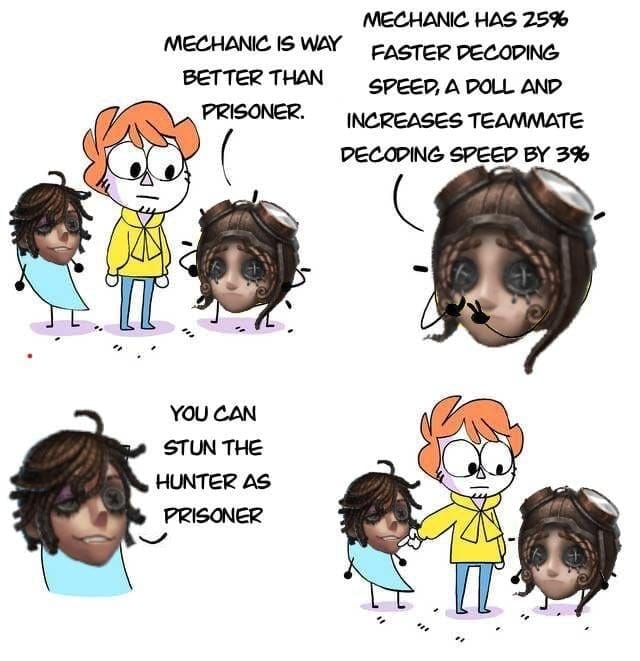
Prisoner's connections link two ciphers, distributing decoding progress. When Mechanic's robot decodes a connected cipher at 200% speed, accelerated progress transfers partially to the connected machine, creating 1.5x effective decoding rate. This completes two ciphers in ~135 seconds vs 162 seconds independently—a 27-second advantage compounding across five ciphers.
Optimal pattern positions Prisoner on central cipher connecting to Mechanic's robot cipher and a third decoder's cipher. This three-way connection distributes robot's accelerated progress across multiple machines. Teams achieving this complete five ciphers in 240-255 seconds.
Connection Priority:
Connect robot cipher to central cipher for max distribution
Avoid connecting ciphers in Hunter patrol routes
Reconnect immediately after rescues
Position Prisoner centrally to minimize break risk
Rescue Chain Optimization
Rescue chains succeed through coordinated timing. Antiquarian's 49% Stage 1 rescue success demonstrates pro-level difficulty. Optimal rescue timing occurs at 50% chair progress—early enough to prevent Stage 2 but late enough to maximize decoder uptime.
Double rescue executes chains where Gravekeeper attempts first rescue using shovel. If Gravekeeper gets downed, Mercenary executes secondary rescue using elbow pad absorption. This maintains rescue capability even when first rescue fails.
Positioning:
Primary rescuer positions 20m from chair, monitoring Hunter
Secondary rescuer maintains 30-40m distance
Decoders continue until rescue confirmation
Rescued Survivor transitions to pre-planned kiting route
Kiter Support Systems
Pro kiting extends beyond individual skill through team support. Seer's owl provides 5-second protection during critical moments—used when kiters reach unsafe zones or Hunters activate abilities. This allows kiters to reach next structure, extending chases by 15-20 seconds per owl.
Psychologist's hypnosis creates 10-second windows where Hunters lose ability access. Teams coordinate hypnosis for specific scenarios: interrupting Breaking Wheel spikes, disrupting Dream Witch followers, negating Opera Singer notes.
Support Coordination:
Seer reserves owl for kiter emergencies
Psychologist times hypnosis to interrupt Hunter abilities
Decoders call cipher completion percentages
Rescuers communicate position for kiter transitions
Flex Role Responsibilities
Flex players fill gaps in specialized compositions, adapting based on match flow. In decoder rush, flex players handle extended kiting when primary kiters get downed early. In rescue comps, flex players maintain decoder progress while dedicated rescuers execute chains.
The 10-15% performance gap between specialists and flex becomes acceptable when flex enables specialists to perform optimally.
Flex Decision Trees:
If primary kiter downed: Flex assumes kiting
If rescuer downed: Flex evaluates rescue vs decoder continuation
If decoder downed: Flex completes ciphers while specialists handle pressure
If Hunter camping: Flex maximizes decoder progress
Hunter Meta Analysis
Top 3 Hunter Picks in COA IX
Breaking Wheel leads with 35/35 rating for versatility across all maps and Survivor comps. Spike mechanics create guaranteed damage ignoring kiting skill. Wheel form provides mobility for cipher pressure. Camp-control through spike placement makes rescues extremely risky.
Sculptor maintains 34/35 rating through statue mechanics controlling zones and punishing rescues. Web placement slows decoder progress while statues near chairs create unavoidable damage during rescues.
Nightmare and Violinist emerge as mobility-specialists countering decoder rush. Nightmare's teleport enables rapid cipher pressure, interrupting Prisoner connections. Violinist's notes create map-wide pressure disrupting decoder coordination.
Why Sculptor Remains Perma-Ban
Sculptor's statues create permanent map control persisting throughout matches. Unlike ability-based Hunters requiring active presence, statues maintain zone control passively, enabling chair camping while simultaneously pressuring distant ciphers.
Web mechanic slows decoder progress by 30-40%, extending cipher completion time for multiple downs before five ciphers complete. Pro Sculptor players position webs on central ciphers Survivors must eventually decode.
Nightmare and Opera Singer: Rising Threats
Nightmare's teleport counters decoder rush's fundamental assumption—that Hunters require time to traverse maps. Teleport enables instant pressure on any cipher, breaking Prisoner connections and forcing Mechanic robot recalls.
Opera Singer's notes create unavoidable damage through sound wave propagation, countering kiting-focused comps. Notes during chases force predictable pathing, enabling Singers to secure downs 20-30 seconds faster.
Counter-Strategy:
Against Nightmare: Spread decoders across map, avoid connection-dependent strategies
Against Opera Singer: Prioritize decoder rush over kiting extension
Hunter Trait and Persona Optimization
Pro Hunters optimize traits and personas for specific comps and maps. Blink remains universal for mobility and chase. Teleport sees usage on large maps requiring rapid traversal. Trump Card provides comeback potential late-game.
Persona builds prioritize Detention for late-game pressure, ensuring one-hit downs after final cipher. Confined Space reduces pallet stun duration. Tinnitus reveals decoder positions.
Map-Specific Composition Adjustments
Red Church: Open Spaces
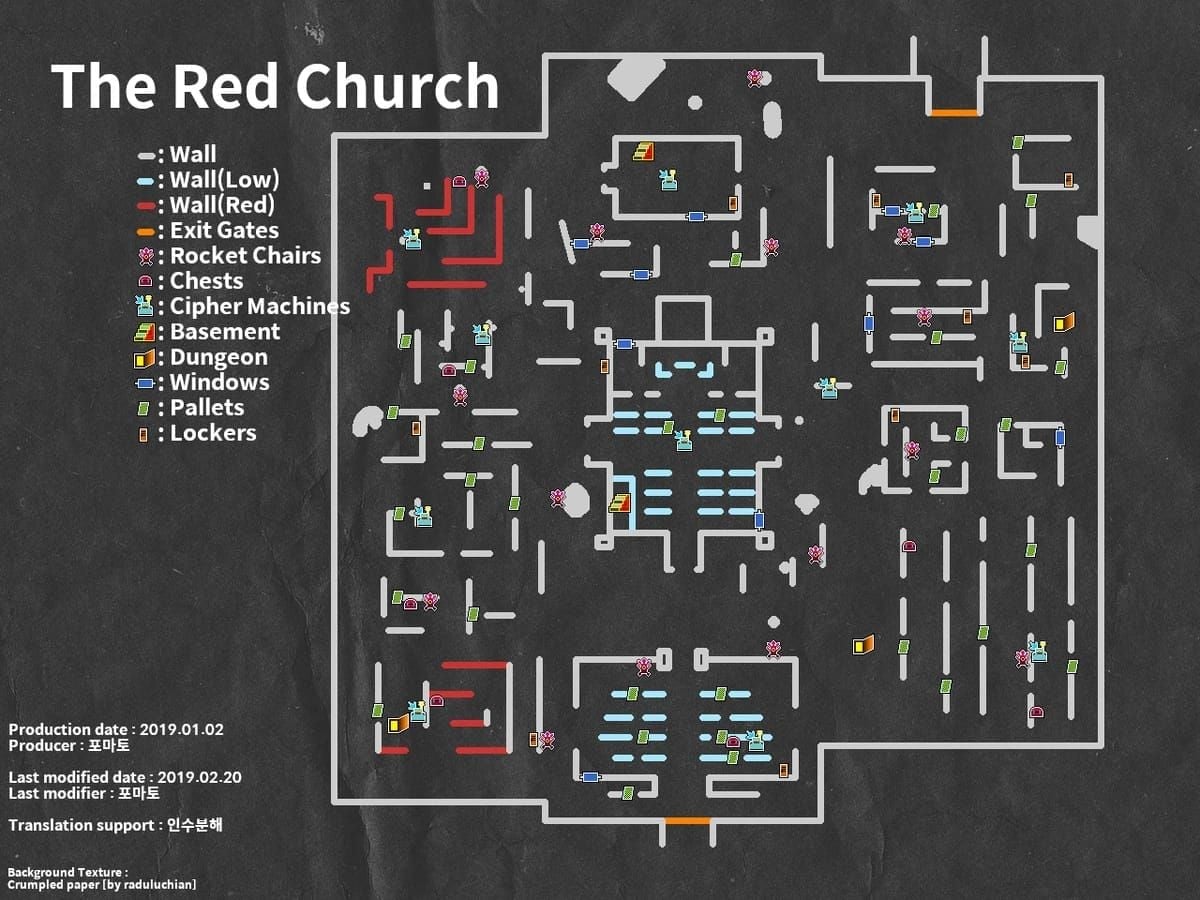
Red Church's open graveyard and limited kiting structures favor decoder rush over kiting-focused setups. Sightlines enable Hunters to maintain visual contact, reducing kiting duration. Decoder rush completes ciphers before kiting becomes necessary.
Optimal: Prisoner, Mechanic, Seer, Mercenary. Prisoner establishes connections between church, graveyard, and basement ciphers. Mechanic's robot decodes graveyard while Prisoner works church.
Execution:
Avoid extended kiting in open graveyard
Prioritize church and basement ciphers for connection safety
Use Seer owl for decoders not kiters
Complete 3-4 ciphers before first down
Eversleeping Town: Decoder vs Rescue
Tight corridors create natural rescue difficulty, making rescue-focused comps less effective. Structure favors Hunters during chair camping. Decoder rush minimizing rescue requirements performs better.
However, cipher positioning creates connection difficulties for Prisoner. Ciphers cluster in town center with limited separation. Hybrid compositions balancing decoder efficiency with single rescue capability provide optimal performance.
Moonlit River Park: Transition Kiting
Central structure enables transition kiting through coordinated rotations. Building provides extended kiting for first kiter, who transitions to second kiter near riverside structures. This extends combined kite to 100-150 seconds, enabling 2-3 cipher completions before first down.
Optimal: Painter, Batter, Mechanic, Gravekeeper. Painter initiates kiting using central building, employing canvas to waste 60-90 seconds. Batter positions near riverside, ready to receive transition and extend another 40-60 seconds.
Transition Coordination:
Painter calls transition timing when reaching unsafe zones
Batter positions to receive kiting without double-down risk
Mechanic prioritizes distant ciphers during kiting
Gravekeeper prepares rescue at 40% chair progress
Lakeside Village: Tight Corridors
Corridor structure creates rescue advantages through limited Hunter patrol routes. Rescuers can predict Hunter position based on corridor access. Double rescue excels on Lakeside.
Optimal: Mercenary, Gravekeeper, Prisoner, Mechanic. Mercenary and Gravekeeper execute rescue chains through different corridor approaches, preventing Hunter from blocking both routes.
Adapting Pro Comps to Ranked
Skill Floor Considerations
Decoder rush requires Prisoner players maintaining connection awareness—breaking connections wastes 10-15 seconds per break. Ranked teams should only run decoder rush if Prisoner demonstrates consistent connection maintenance across practice matches.
Transition kiting demands precise communication where first kiter calls transitions before getting downed. Mistimed transitions cause double downs. Ranked teams need voice communication and practiced timing.
Minimum Skills by Composition:
Decoder Rush: Prisoner connection maintenance, Mechanic robot positioning
Double Rescue: Gravekeeper shovel timing, Mercenary elbow pad management
Transition Kiting: Communication discipline, kiter positioning awareness
Control Comp: Psychologist hypnosis timing, Seer owl conservation
Hybrid Comp: Role flexibility, adaptive decision-making
Communication Requirements
Decoder rush requires constant callouts: connection status, cipher percentages, Hunter proximity. Teams lacking voice should avoid decoder rush—text delays break connections.
Transition kiting demands real-time coordination: transition timing, position updates, Hunter ability status. Text-based systems create double-down risks.
Communication Minimums:
Voice for transition kiting and decoder rush
Quick chat suffices for hybrid comps
Rescue comps require rescue timing calls (voice or quick chat)
Control comps need ability usage coordination (voice recommended)
Common Mistakes Copying Pro Setups
Ranked teams copy pro comps without understanding execution requirements. Most common mistake: running decoder rush without Prisoner connection discipline—broken connections eliminate the 27-second advantage.
Another error: deploying transition kiting without practiced transitions. Teams attempting transitions first time in ranked mistimed calls, creating double downs.
Avoidable Errors:
Running specialist comps without role specialists (use hybrid)
Attempting transition kiting without voice
Deploying decoder rush without connection practice
Using control comps against chase-oriented Hunters
Simplified Versions for Tier IV-V
Tier IV-V teams should prioritize hybrid compositions maintaining baseline functionality. Simplified hybrid: Forward, Mechanic, Seer, Gravekeeper—provides decoder efficiency, rescue capability, support, and kiting potential without demanding specialist execution.
This tolerates errors: if Forward mistimes rescue, Gravekeeper provides backup. If Mechanic gets downed early, Forward and Gravekeeper can kite adequately. This error tolerance makes hybrid ideal for ranked teams developing skills.
Identity V Echoes top up instant delivery through BitTopup provides secure transactions and competitive rates for essential characters and personas.
Counter-Strategies: Beating Meta Compositions
Counter Decoder Rush
Decoder rush collapses when Hunters apply sustained cipher pressure breaking Prisoner connections and forcing Mechanic robot recalls. Nightmare and Violinist excel through mobility enabling rapid cipher rotation.
Ban phase targets Mechanic first, removing 200% decoding speed. Without Mechanic, decoder rush loses 15-20% efficiency. Second ban targets Prisoner, eliminating connections entirely.
Hunter Counter-Picks:
Nightmare: Teleport enables instant cipher pressure
Violinist: Notes create map-wide pressure
Opera Singer: Sound waves force decoder repositioning
Breaking Double Rescue
Double rescue fails against camp-control Hunters creating unavoidable damage zones near chairs. Sculptor's statues and Breaking Wheel's spikes punish rescues regardless of skill.
Ban phase targets both rescuers—banning Mercenary eliminates 3-hit absorption, banning Gravekeeper removes shovel mechanics.
Camp-Control Selections:
Sculptor: Statues create unavoidable rescue damage
Breaking Wheel: Spikes punish rescue approaches
Clerk: Pages control chair zones
Hunter Picks Punishing Specific Comps
Transition kiting requires Hunters downing kiters before transitions. Chase-oriented Hunters like Ripper and Geisha excel through basic attack efficiency securing downs in 40-50 seconds—faster than transition windows.
Control comps become ineffective against chase-oriented Hunters relying on basic attacks. Ripper and Geisha maintain full effectiveness despite Psychologist hypnosis and Seer owl.
Survivor Counter-Picks
Against decoder rush, select characters with cipher pressure resistance—Wildling's boar provides emergency kiting when Hunters interrupt decoders. Forward's football enables decoder protection through stuns.
Against rescue-focused comps, select Survivors with self-sufficient kiting. Perfumer's perfume and Acrobat's bomb enable extended solo kiting, allowing decoder continuation rather than risky rescues.
Preparing for COA IX Meta
Setting Up Scrim Sessions
Sacred Sanctum's 60-match max with 6 daily matches (12:00-22:00) provides optimal scrim scheduling. Conduct 2-3 scrim blocks daily: early block (12:00-15:00) testing new comps, mid block (16:00-19:00) refining execution, late block (20:00-22:00) simulating Divine Procession's 19:00-21:00 window.
Scrim Structure:
Pre-scrim planning: Define composition, assign roles, establish success metrics
Match execution: Run comp against scrim partner, record performance
Post-scrim review: Analyze errors, identify improvements, adjust strategy
Iteration: Repeat with refinements until target performance
Character Mastery by Role
Hunter specialists require mastery of 2-3 Hunters covering niches: one camp-control (Sculptor, Breaking Wheel), one mobility-specialist (Nightmare, Violinist), one chase-oriented (Ripper, Geisha).
Survivor specialists need deep expertise in role category: decoder specialists master Prisoner and Mechanic, rescuer specialists master Mercenary and Gravekeeper, kiter specialists master Painter and Batter. Flex players require competency across multiple roles.
Mastery Benchmarks:
Decoder specialists: Maintain Prisoner connections 90%+ of match, position Mechanic robot optimally
Rescuer specialists: Achieve 60%+ rescue success vs camp-control Hunters
Kiter specialists: Sustain 60+ second kites vs chase-oriented Hunters
Hunter specialists: Secure first down within 90 seconds, maintain cipher pressure
Optimizing Accounts with BitTopup
Competitive accounts require unlocked characters, optimized personas, and cosmetic items providing gameplay advantages. BitTopup provides secure Identity V Echoes top-up with instant delivery, competitive pricing, and excellent customer service.
Teams preparing for Online Qualifiers should prioritize character unlocks based on comp requirements: Prisoner and Mechanic for decoder rush, Mercenary and Gravekeeper for rescue, Painter and Batter for transition kiting.
Tracking Meta Shifts
Meta evolves throughout Sacred Sanctum and Divine Procession as teams discover counter-strategies. Monitor top 100 performance data, tracking which comps achieve highest win rates and which Hunters dominate bans.
Transition from Sacred Sanctum to Divine Procession reveals meta shifts as teams abandon exploratory strategies for proven comps. Monitoring this identifies which comps survived testing.
Meta Tracking:
Record top 100 team comps from Sacred Sanctum matches
Track Hunter and Survivor ban rates across regions
Monitor pro team social media for comp reveals
Analyze Radiant Altar finals (Jan 22-29, 2026) for championship strategies
FAQ
What are the best survivor compositions for COA IX qualifiers?
Decoder rush featuring Prisoner-Mechanic cores dominate due to 81-second cipher completion and 240-270 second five-cipher completion. Double rescue with Mercenary-Gravekeeper provides reliable rescue chains. Hybrid compositions balancing Forward-Wildling-Mechanic-Seer offer error tolerance for Tier IV-V teams.
How do professional Identity V teams draft compositions?
Pros first-pick flex characters revealing minimal info (Seer, Forward), then select core enablers after opponent bans reveal concerns. Fourth picks complete synergy with specialists. Fifth Hunter picks directly counter opponent Survivor comps. This conceals strategy until opponents commit to bans.
Which hunters are most banned in COA IX scrims?
Dream Witch faces 75-80% pick/ban rate for follower mechanics creating multi-zone pressure. Sculptor maintains perma-ban at 34/35 rating through statue camp-control and web decoder slowdown. Breaking Wheel receives priority bans at 35/35 rating for spike mechanics ignoring kiting patterns.
What's the difference between scrim comps and ranked comps?
Scrim comps prioritize specialist execution and perfect coordination tested across dozens of matches. Ranked comps require error tolerance and simplified communication for limited practice time. Scrim comps exploit narrow advantages (27-second decoder gains) requiring precise execution. Ranked comps maintain baseline functionality despite errors through hybrid selections.
How to counter the top 6 COA IX team compositions?
Counter decoder rush through Nightmare/Violinist applying sustained cipher pressure breaking Prisoner connections. Break double rescue using Sculptor/Breaking Wheel camp-control creating unavoidable rescue damage. Defeat transition kiting with Ripper/Geisha securing downs in 40-50 seconds before transitions. Ban phase targeting removes enablers—Mechanic for decoder rush, Mercenary for rescue, Painter for transition kiting.
What role does Prisoner play in competitive Identity V?
Prisoner enables decoder rush through connections distributing decoding progress between ciphers. Connecting Mechanic's robot cipher (200% speed, 81-second completion) to central cipher creates 1.5x effective decoding rate. Optimal three-way connections complete two ciphers in 135 seconds vs 162 independently—27-second advantages compounding across five ciphers for 240-255 second total completion under perfect execution.